

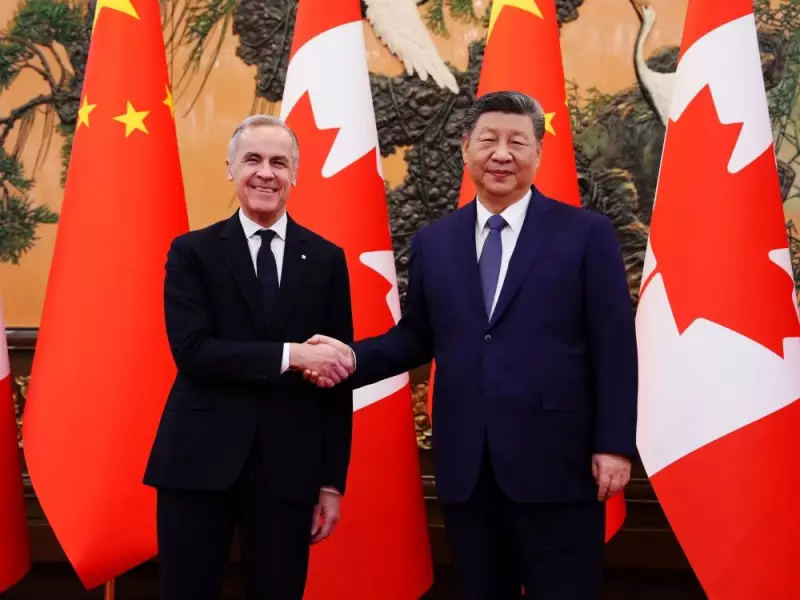
Prime Minister Mark Carney's government has embarked on a significant and controversial economic partnership with China, a move critics argue dangerously ignores escalating military threats against Taiwan. The deal, announced on Friday, January 16, 2026, during Carney's meeting with President Xi Jinping in Beijing, promises short-term trade gains but could leave Canada in a profoundly compromised position should conflict erupt in the Indo-Pacific.
The Details of the Deal: Canola for Cars
The three-year agreement will see Canada relax tariffs on key agricultural exports like canola, peas, and seafood. In return, China will be permitted to export 49,000 Chinese-made electric vehicles (EVs) to the Canadian market annually. Announcing the pact, Carney framed it as a strategic move, stating it "sets us up well for the new world order." The deal is widely seen as an attempt to hedge against strained trade relations and a deteriorating diplomatic climate with the United States under President Donald Trump.
A Gathering Storm: China's Military Buildup
This economic overture unfolds against a backdrop of intensifying Chinese military aggression directed at Taiwan, a democratic island Canada recognizes as a key partner. Over the past year, intelligence reports and satellite imagery have revealed Beijing's extensive preparations, which include:

- Retrofitting civilian cargo ships with drone and missile launchers.
- Building and testing new amphibious landing craft.
- Significantly expanding arms production facilities.
- Conducting larger and more frequent military drills encircling Taiwan.
These actions follow a 2023 directive from President Xi Jinping, revealed by U.S. intelligence, instructing the People's Liberation Army to be ready to invade Taiwan by 2027. Notably, this readiness deadline falls squarely in the middle of Canada's newly minted three-year trade agreement with Beijing.
A Cautionary Tale: Germany's Nord Stream 2 Blunder
The current situation bears a stark resemblance to European missteps prior to Russia's invasion of Ukraine. In the summer of 2021, even as Russia massed troops on Ukraine's border, Germany finalized the Nord Stream 2 pipeline deal, deepening its energy dependence on Moscow. German officials, having phased out domestic nuclear and coal power, dismissed security risks, believing economic interdependence would prevent war.
The strategy failed catastrophically. Russia invaded Ukraine in February 2022. Germany was forced into an awkward, last-minute suspension of Nord Stream 2, which was later sabotaged. The nation was left scrambling for alternative energy sources and has since been compelled to make massive, unplanned increases in defence spending.
"We’ve already seen how this kind of thing goes, and it ends with an egg on the face," the scenario warns.
Canada's Precarious Position
Like pre-war Germany, Canada is pursuing deeper economic ties with an authoritarian state explicitly preparing for war. The domestic rationale is clear: the deal offers relief to Canadian farmers and provides consumers with more affordable EV options amid high prices and quality concerns about North American models. It also appeals to political sentiments aimed at asserting independence from the U.S.
However, this creates a looming dilemma. If China invades Taiwan before or after the 2027 timeline, Canada would face an acute crisis. Would it sever the lucrative new trade relationship to support a democratic ally and uphold international law? Or would it issue condemnations while continuing business, undermining its geopolitical credibility and moral stance?
The Carney government's gamble prioritizes immediate economic and political calculations over long-term strategic foresight. As China's military clock ticks toward 2027, Canada may find itself, like Germany before it, entangled in a dependency that becomes a severe liability in a world where trade and security are inextricably linked.






