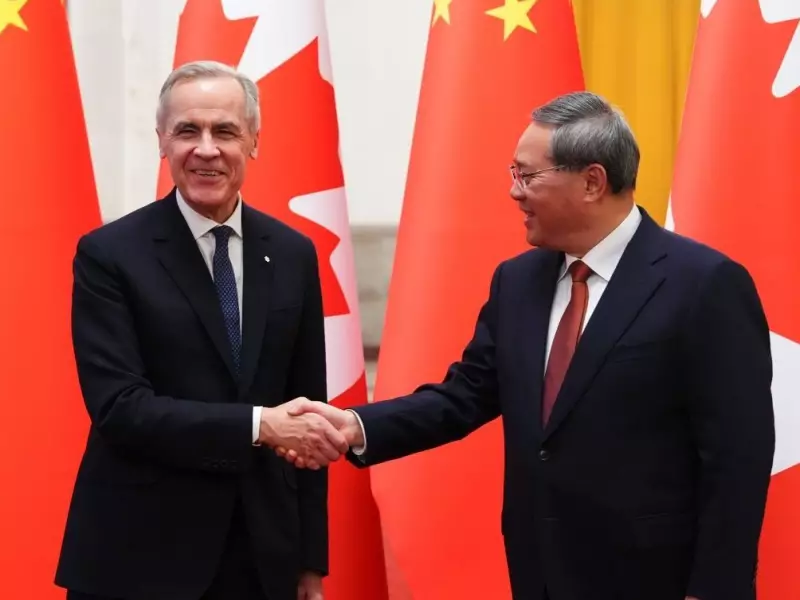
Prime Minister Mark Carney's recent trade agreement with China has ignited a fierce debate, placing Canada's economic interests in direct tension with its national security priorities. The deal, struck in January 2026, allows a number of Chinese electric vehicles into the Canadian market in return for Beijing reducing tariffs on Canadian canola and other agricultural products.
A Deal Forged from Necessity
The editorial argues this agreement stems from Canada being stuck between a rock and a hard place. With U.S. President Donald Trump asserting that the United States no longer needs many Canadian products and threatening to use tariffs as a barrier, the Liberal government felt compelled to act. Carney's position is that thawing relations with China, Canada's second-largest trading partner after the U.S., is an economic necessity.
This shift is described as part of a "new world order" for Canada, seeking closer ties with China while simultaneously creating some distance from the United States. The move is seen as a strategic hedge against the potential collapse of the Canada-United States-Mexico Agreement (CUSMA).

Security Threats Cast a Long Shadow
However, the editorial raises profound concerns about partnering with a nation Carney himself labeled as Canada's "greatest security threat" during the last federal election. These fears are backed by the findings of Canada's foreign interference inquiry, which identified China as "the most persistent and sophisticated foreign interference threat" to the country.
The evidence presented was stark, including:
- China-controlled police stations operating on Canadian soil.
- Campaigns targeting specific Canadian politicians for electoral defeat.
- A coordinated campaign of transnational repression against Canadians of Chinese origin advocating for human rights.
The editorial questions the wisdom of expecting China to alter its long history of intellectual property theft, industrial espionage, and copyright infringement simply because of a handshake between Carney and Chinese President Xi Jinping. While the current deal may be largely symbolic, it is viewed as a precursor to more significant agreements in the future.
Promised Guardrails and Political Scrutiny
In response to these concerns, Prime Minister Carney has promised to install "guardrails" around the cooperation. These would explicitly exclude sensitive sectors like artificial intelligence, critical minerals, and defence from the partnership. The government's goal is to engage economically while attempting to wall off areas crucial to national security.
Yet, skepticism remains high. The editorial points to the government's own track record, noting that the Liberals have talked about but failed to establish a functional foreign lobbyists' registry for five years. This failure undermines confidence in the administration's ability to manage the complex and opaque nature of dealings with the Chinese state.
Critics, including Ontario Premier Doug Ford, have already blasted the arrangement as a "lopsided" deal for Canada. Interestingly, Donald Trump has reportedly called Carney's decision to sign a trade pact with China a "good thing," highlighting the unusual geopolitical alignments the situation has created.
The core argument concludes that while diversifying trade away from over-reliance on the United States is a prudent goal, Carney's primary duty is to keep Canadians safe. The editorial warns that if the government repeats past mistakes—such as courting Chinese elites while accepting political donations and bargaining with national security for trade gains—this "landmark" deal could swiftly become another foreign policy and security disaster for the nation.