

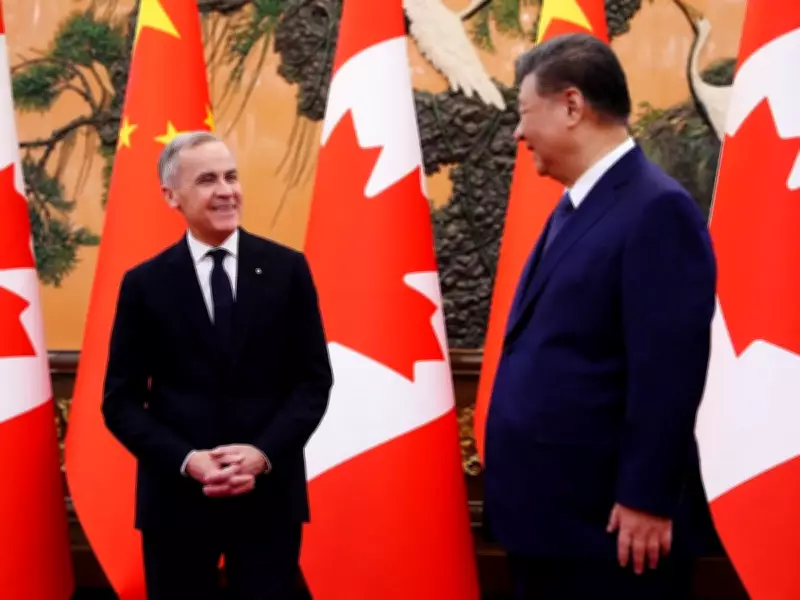
Carney's China Strategy Draws Sovereignty Concerns from Analyst
Prime Minister Mark Carney's recent diplomatic maneuvers toward China have sparked significant debate about Canada's future economic and political independence. During his appearance at the Davos conference, Carney advocated for a strategic decoupling from the United States while simultaneously pursuing a deeper partnership with China. This approach has received mixed reactions, with some international observers praising the bold shift, while domestic critics voice alarm about the long-term implications for Canadian autonomy.
The Economic Imbalance in Canada-China Relations
At the heart of the controversy lies a fundamental economic imbalance. The current framework of Canada-China trade heavily favors Chinese manufacturing interests over Canadian economic development. Recent agreements essentially position Canada as a supplier of raw materials—such as minerals, lumber, and agricultural products—in exchange for finished manufactured goods from China. This arrangement proves far less lucrative for Canada than value-added domestic production would be, creating what analysts describe as a colonial-style economic relationship.
The trade numbers reveal a troubling trend: In 2024, Canada exported approximately $30 billion worth of products to China while importing nearly three times that amount. This has caused Canada's trade deficit with China to balloon dramatically, growing from $22 billion in 2005 to $57 billion in 2024. This widening gap suggests Canada is becoming increasingly dependent on Chinese goods while failing to develop its own manufacturing capacity.

China's Global Strategy and Canadian Vulnerability
China's international economic strategy follows a consistent pattern that should concern Canadian policymakers. Rather than fostering genuine partnerships that develop local industries—as Western capital has historically done in Southeast Asia and India—China primarily seeks to secure control over resource-rich nations. This approach creates client states that remain perpetually dependent on Chinese manufacturing and technology.
"China's clear intention is to establish global hegemony through trade relationships that create vassal states," notes analyst Joel Kotkin. "These nations are then expected to align with Beijing's political agenda in exchange for continued economic access."
This pattern is evident across multiple continents. In Africa, China has systematically gained control of resource extraction while limiting industrial development in partner nations. In Southeast Asia, China's aggressive territorial claims in the South China Sea demonstrate its willingness to use economic relationships to advance geopolitical objectives. Several nations—including Cambodia, Laos, and Mauritius—already function largely as economic vassals to Beijing.
Political Implications for Canadian Sovereignty
The political dimension of Carney's China pivot raises equally serious concerns. Unlike the United States with its alternating political leadership, China operates as a permanent one-party dictatorship with consistent long-term objectives. By aligning Canada more closely with Beijing, Carney risks subjecting Canadian foreign policy to Chinese influence and undermining traditional alliances with democratic nations.
Russia provides a cautionary example of this dynamic. Once a proud global power, Russia has become increasingly dependent on Chinese manufacturers and technology in exchange for access to its vast natural resources. This relationship has significantly diminished Russian sovereignty and global influence—a fate that could potentially await Canada if current trends continue.
The American Response and Economic Consequences
Carney's strategic shift toward China carries significant risks regarding Canada's relationship with its southern neighbor. The United States has historically been Canada's largest trading partner, with Canada generally enjoying a trade surplus in this relationship. A dramatic reorientation toward China could provoke American retaliation that might devastate key sectors of the Canadian economy.
Potential consequences include:

- Trade restrictions on Canadian exports to the United States
- Reduced investment from American companies in Canadian industries
- Strained diplomatic relations affecting cross-border cooperation
- Diminished Canadian influence in North American economic policy
While Carney's criticism of former President Donald Trump and "MAGA" politics may win temporary domestic political points, it risks alienating Canada's most important economic partner during a period of global uncertainty.
Historical Parallels and Future Concerns
China's current international strategy bears striking resemblance to historical patterns of imperial expansion. During the 15th century, China established tributary relationships with neighboring states like Vietnam, Korea, and Ceylon (modern-day Sri Lanka). These nations provided resources and acknowledged Chinese cultural superiority in exchange for trade access and protection.
Contemporary Chinese officials deny any imperial ambitions, but their actions suggest otherwise. The Belt and Road Initiative, often presented as developmental aid, frequently functions as a mechanism for debt diplomacy. Nations unable to repay Chinese loans find themselves forced to grant additional concessions, further eroding their sovereignty.
For Canada, the path forward requires careful consideration of both economic opportunities and sovereignty risks. While diversification of trade relationships makes strategic sense, becoming economically dependent on an authoritarian regime with hegemonic ambitions represents a dangerous course. As Canada navigates this complex geopolitical landscape, maintaining balanced relationships with both democratic allies and emerging powers will prove essential to preserving national independence and economic prosperity.





