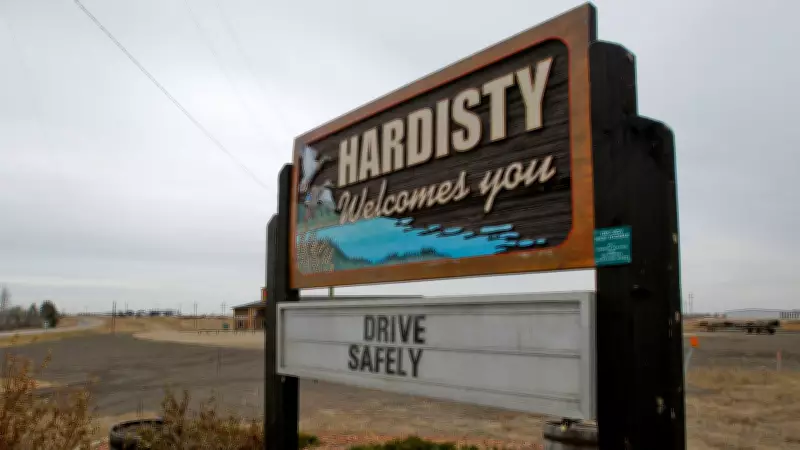
Brett Baumgartner’s alarm sounds at 5 a.m. four days a week. He quickly prepares a lunch, hops into his pickup truck, and drives a short distance to what locals in Hardisty, Alberta, call the Hill. This vast industrial complex hosts about 100 dome-capped oil storage tanks, each five storeys high and 50 metres across. Baumgartner estimates that 80 per cent of working-age residents work on the Hill.
Hardisty, with a population of just 623, is the most important oil town in Canada. Without it, there would be no gasoline for cars, asphalt for roads, jet fuel for flights, or billions in oil revenues flowing to Alberta and Ottawa. It may be a tiny dot on the map, but its impact on Canada’s welfare is immense.
The Heart of Canada's Oil Network
Fed by pipelines from Alberta and Saskatchewan, the tanks and subterranean caverns on the Hill have a combined storage capacity of 38 million barrels of oil. Millions of barrels are piped daily to the United States. The mayor, also a field operator, climbs to the top of tanks to sample oil for testing. In winter, the task is challenging.

Hardisty is the headwaters of oil country, where Canadian hydrocarbon wealth flows to refineries in Sarnia, Montreal, Chicago, Texas, and Louisiana. About $501 million of oil is exported through Hardisty daily, totaling over $180 billion annually, according to Invest Alberta. This money supports hospitals, highways, ports, and other public services.
Richard Masson, former CEO of the Alberta Petroleum Marketing Commission, calls Hardisty vital. “It is the big origination hub for Alberta crude,” he says.
Population Paradox
Despite its economic importance, Hardisty’s population has barely grown. Founded in 1907 as a railway stop, it had 536 residents in 1951 and 564 in 2000. Mayor Baumgartner hopes the 2026 census will show an increase, but growth remains elusive. The average household income in 2021 was $117,000, and companies like Enbridge, Gibson Energy, and Husky Midstream pay well. However, the town struggles to attract new residents and businesses.
“It is the strangest thing,” Baumgartner says. “You would think with everything on the Hill, more people would live here. We have been doing our best, but it has been slow going.”
Comparison with Cushing, Oklahoma
Economist Joseph Marchand of the University of Alberta compares Hardisty to Cushing, Oklahoma, another oil hub with 98 million barrels of storage capacity. Cushing’s population has also stagnated. Marchand notes that booms in such towns are often temporary, tied to construction phases. For instance, Enbridge built three new tanks in Hardisty with 150 temporary workers, but they left once the project ended.
“If the Iran war drags on, places like Hardisty might boom, but it’s short-term growth,” Marchand says.
Community Spirit and Challenges
Hardisty boasts strong volunteer groups, including the Agricultural Society, Rodeo Association, and Legion, which run local amenities. Former town manager Tony Kulbisky says residents are proactive. The town set aside land for development and invested in water and sewer infrastructure during the Keystone XL pipeline discussions, which remain pending.
In December 2024, Hardisty released a promotional video highlighting its community spirit, hockey, waterskiing, and fishing. Ashley Hilton, an industrial medic, moved from Calgary for affordability and safety. She pays $1,200 a month for a three-bedroom house and feels welcomed as part of a same-sex couple.
“People look out for one another here,” she says. “We are in for the long haul.”
Future Prospects
Real estate agent Connie Beringer has sold 18 houses in 24 months, with three-bedroom homes under $200,000. She receives calls from Ontario and British Columbia. However, Mayor Baumgartner wants more businesses to open on Main Street. He cold-emails companies to pitch Hardisty as a location.
A recent win: the Alberta government approved a charter school to replace the closed K-9 public school. A fundraiser collected $200,000 for the new school opening in September. “Hardisty is a great place to live,” Baumgartner says. “We just want more people to move here.”