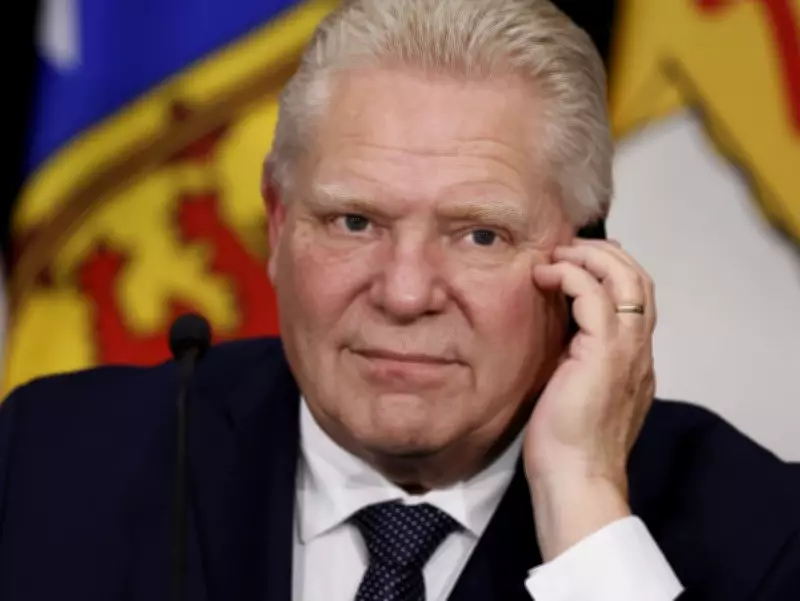
Ontario Premier Doug Ford, who once vocally criticized provincial deficits under former Liberal premier Kathleen Wynne, has undergone a notable transformation in his fiscal approach since taking power in 2018. His government's 2026 budget, released on Thursday, March 26, 2026, underscores this shift with a record-high $244.2 billion spending plan that projects a substantial $13.8 billion deficit for the year.
Escalating Deficits and Delayed Surpluses
This year's deficit is a staggering 77% higher than the $7.8 billion shortfall predicted in the previous budget. The financial outlook has deteriorated further, with earlier projections of a $200 million surplus in 2027 now revised to a $6.1 billion deficit. A balanced budget with a modest $600 million surplus has been pushed back to 2028, continuing a trend where balanced book predictions are routinely postponed in subsequent budgets.
Mounting Debt and Interest Payments
Ontario's total debt is projected to climb sharply, reaching $485.1 billion in 2026, $514.4 billion in 2027, and $529.3 billion in 2028. By 2028, the provincial debt will be 56.8% higher than the $337.6 billion inherited by the Ford government in 2018. Interest payments on this debt are a growing burden, with $16 billion allocated for 2025, rising to $17.2 billion in 2026, $18.6 billion in 2027, and $19.7 billion in 2028. If interest-on-debt were treated as a government ministry, it would rank as the fourth-largest after health care, education, and social services.

Economic Context and Government Justifications
The budget attributes the "sea of red ink" to "economic and geopolitical uncertainty and an evolving global landscape, as trade tensions and supply chain pressures impact the economy." Despite these challenges, Ford has not delivered a balanced budget in his eight years in office. While the 2025 deficit came in at $12.3 billion, $2.3 billion less than the 2024 prediction of $14.6 billion, the pattern of deferring fiscal balance persists.
Positive Measures Amid Fiscal Strain
On a brighter note, the budget includes several initiatives aimed at stimulating the economy and providing relief. A 13% HST rebate for new homebuyers offers up to $130,000 for homes valued at up to $1 million, with partial rebates available for homes up to $1.85 million. Additionally, the small-business corporate income tax rate will be reduced by 30%, from 3.2% to 2.2%, starting in July 2026.
Long-Term Fiscal Implications
The net debt-to-GDP ratio, a key indicator of fiscal health, is projected to be 38.2% in 2028, slightly improved from 39.3% in 2018. However, the overall debt trajectory raises questions about sustainability. Ford's earlier criticisms of Wynne's management, which highlighted Ontario having the largest subnational debt in the world, now contrast with his own government's expanding liabilities.
This budget reflects a significant evolution in Ford's priorities, focusing on economic support amid global uncertainties while grappling with persistent deficits. As Ontario navigates these fiscal challenges, the long-term impact on public services and taxpayer burdens remains a critical concern for policymakers and citizens alike.