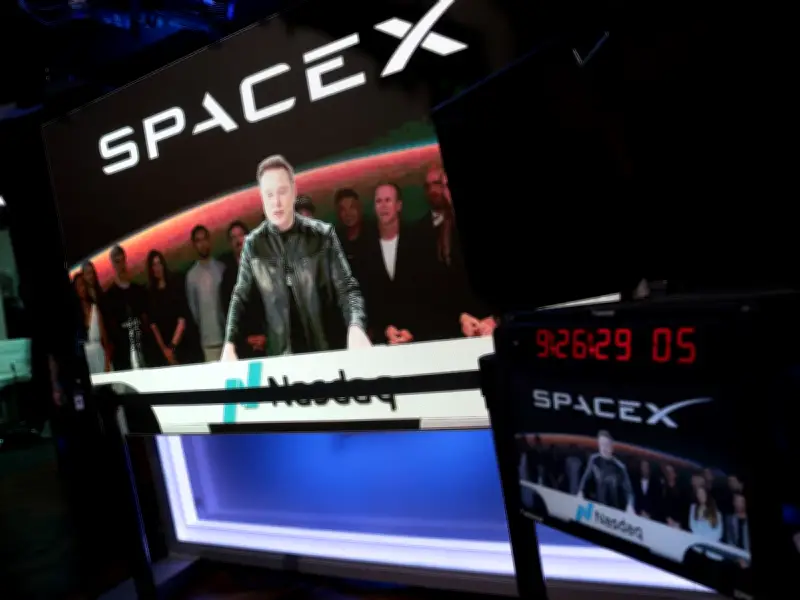
SpaceX joins the Nasdaq 100 Index on Tuesday as Wall Street brokerages launch coverage of Elon Musk’s rocket, satellite and artificial intelligence company with a clear consensus: buy the stock.
Analyst Initiation and Price Targets
At least six brokers, including Morgan Stanley and Goldman Sachs Group Inc., have started coverage with buy-equivalent ratings, following the end of the traditional quiet period for analysts from banks that helped underwrite its US$86 billion initial public offering. Morgan Stanley, among the biggest bulls, set a price target of US$300 per share, implying an 87% gain from Monday’s close of US$160.42. The analysts, led by Adam Jonas, wrote in a note: “While neocloud deals are the bulk of the business near term, we see end-to-end AI services as the longer-term business model.”
Smaller brokerages have more extreme targets. Arete Research has a Street High of US$401, while New Street Research initiated with US$165, the lowest among analysts tracked by Bloomberg. The analyst calls matter because they give investors a framework for valuing SpaceX as more than a Musk-driven moonshot.

Market Context and Bullish Bias
Analysts are leaning into the long-term growth prospects for SpaceX, even as questions over its profitability, execution and valuation continue to linger after a blockbuster market debut. However, sell-side analysts tend to be quite bullish on stocks. For instance, Microsoft Corp. shares have sunk about 30% from their high, but some 95% of analysts covering the stock still have a buy-equivalent rating. Across the 3,000 biggest U.S. companies, buy recommendations account for 63% of all analyst ratings, according to data compiled by Bloomberg. Only 4.2% of ratings are sells.
Index Inclusion and Passive Flows
SpaceX’s addition to the Nasdaq 100 should provide considerable support to the stock, considering the number of funds that track the tech-heavy benchmark. Space Exploration Technologies Corp. won swift entry to Nasdaq Inc.’s main index after rule changes by the exchange operator, allowing newly listed, large-cap companies to be included in as little as 15 trading days, down from the previous three-month minimum. The stock also became a member of the Russell 1000 Index late last month, just two weeks after its IPO. Bloomberg Intelligence analyst Rob Du Boff estimated that SpaceX’s inclusion in the Nasdaq 100 and FTSE Russell gauges would drive at least US$5.4 billion in buying from index-tracking funds. Demand from passive investors might have been even greater, but S&P Dow Jones Indices decided in early June to keep its existing eligibility requirements, closing the door to fast entry by SpaceX into the S&P 500.