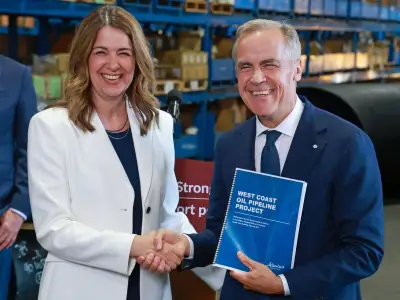
The Privy Council Office added a question to its weekly poll on Nov. 23 asking whether Canadians supported “new or expanded oil pipelines.” The results were clear: 67 per cent approved, including a majority in every province. British Columbia clocked in at 64 per cent, while Quebec reached 56 per cent. On November 27, Prime Minister Mark Carney and Alberta Premier Danielle Smith signed a Memorandum of Understanding to “make Canada a global energy superpower.”
Polling Shows Strong Support for Pipelines
The following week, the government asked a more pointed question: “(D)espite their contribution to the economy, some point out that building pipelines involves cutting corridors across ecosystems, with impacts on nature and habitat, and pipelines come with risks of leaks and spills. Given that, do you support new or expanded pipelines?” Again, a majority of Canadians in every province said yes: 62 per cent nationally, 60 per cent in B.C., and 50 per cent in Quebec.
Though PCO staff is non-partisan, the program is supervised by folks in the Prime Minister’s Office, who are partisan. The polls are designed to help the prime minister, cabinet, PMO staff and bureaucrats take the pulse of the nation. In this case, the pulse showed a clear desire for economic development, even if it involved some environmental impact.

Environment Drops in Priority
This dovetails with a slew of surveys showing that the environment has dropped down Canadians’ priority list. A recent Abacus poll shows the cost of living to be the dominant issue at 67 per cent; “the economy” comes second at 39 per cent. Climate change and the environment sit in ninth place, at 13 per cent — a drop from 29 per cent in 2023, when it was a top three concern.
In other words, Carney is perfectly safe, politically speaking, in approving projects that will eventually see an extra million barrels of oil a day pumped out of the oil sands. This would have been unthinkable under the previous Liberal government of Justin Trudeau.
Irony: From Climate Envoy to Pipeline Advocate
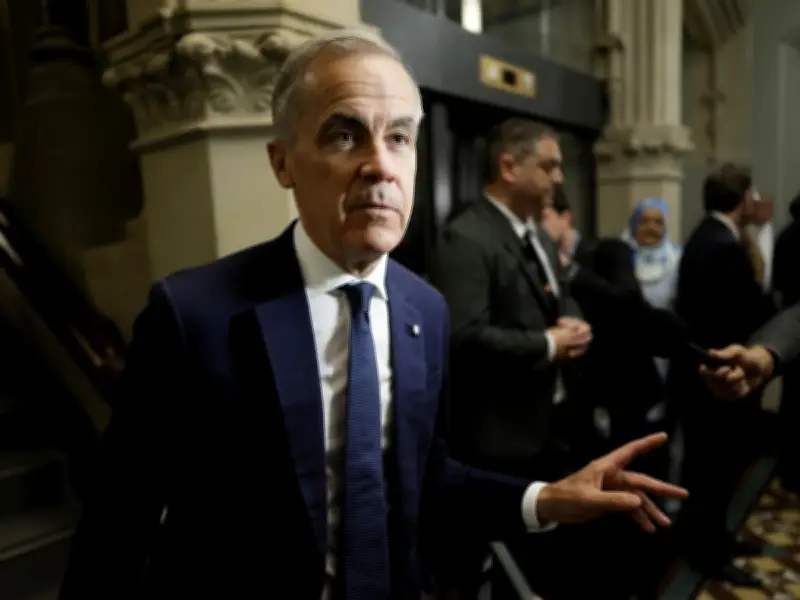
The irony is that in another life, Carney served as the United Nations’ Special Envoy for Climate Action and Finance. He was appointed to the post in December 2019, three months after then-15-year-old Greta Thunberg’s infamous “how dare you” speech at the UN Climate Action Summit in New York. How things have changed in seven years. Last week, Carney was all smiles as he announced that governments in Ottawa and Edmonton would finance a new oil pipeline from Bruderheim, Alta. to Delta, B.C. As for Thunberg, today the 23-year-old has moved on from saving the planet to starting a “global intifada” for “Palestine.”
Yes, the proposed West Coast Pipeline’s southern route avoids the need to reverse the oil tanker moratorium on B.C.’s northwest coast, and the venture is twinned with the Pathways project, a carbon capture project designed to offset rising emissions. But it’s still safe to say that Carney 1.0 might have been a little less enthused.