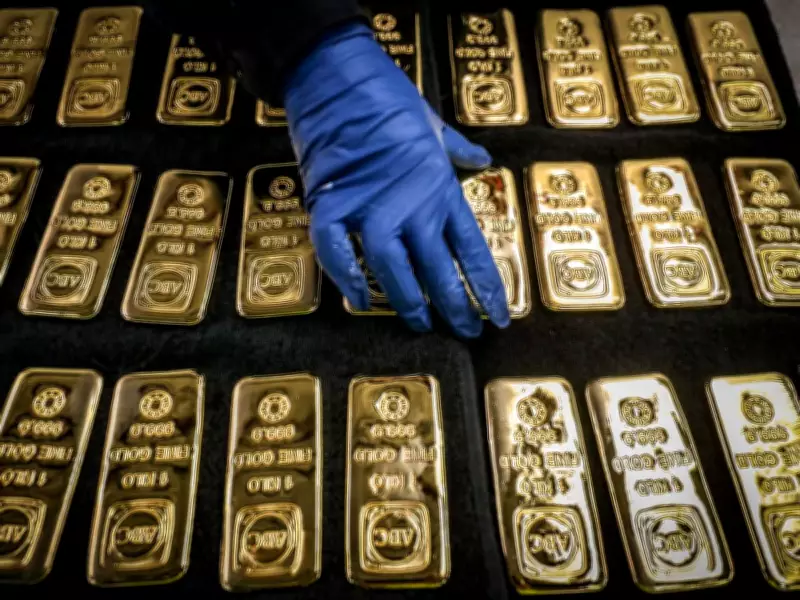
Gold Retreats from Early Gains as Traders Assess Iran Conflict and Fed Rate Outlook
Gold pared some of its early gains on Monday as financial traders carefully weighed the prospect of the Federal Reserve raising interest rates to combat inflation spurred by escalating conflict in the Middle East. The precious metal, which had climbed to a one-month high earlier in the session on strong haven demand, slipped as much as 0.3 percent before trading approximately one percent higher by market close.
Geopolitical Tensions and Monetary Policy Collide
The risk-off mood initially sent global stocks lower before they managed to erase losses throughout the trading day. The U.S. dollar surged while Treasury yields fell amid growing concerns over inflationary pressure from higher oil prices and increased government spending. Oil prices soared the most in four years, adding further complexity to the economic landscape.
President Donald Trump announced that the United States would maintain its military offensive against Iran for as long as necessary, outlining for the first time a set of four specific objectives aimed at reducing what he described as the threat posed by Tehran. This declaration came as Tehran's retaliatory strikes included targeting the United Arab Emirates—a critical artery in the global gold trade that supplies bullion to major buyers in China and India while serving as a key conduit for shipments from London, the world's dominant spot trading hub.

Market Dynamics and Trading Disruptions
According to Frank Monkam, head of cross-asset macro strategy and trading at Buffalo Bayou Commodities, gold's gains were capped as traders began factoring in higher inflation risks that may force the Federal Reserve and its global counterparts to hike interest rates to contain rising price pressures. Swap traders have already scaled back their wagers on the scope of anticipated rate cuts, recognizing that higher interest rates typically prove negative for non-yielding assets like bullion.
The UAE partially closed its airspace and suspended flights in Dubai in response to the attacks, temporarily halting the flow of precious metals. One trader reported that Monday was spent rushing to reroute consignments that had been scheduled to transit through Dubai en route to their final destinations. Gold is typically transported in the cargo holds of passenger aircraft, with many flights operating on the busy London-Dubai route.
Long-Term Implications and Market Sentiment
While these disruptions are expected to be temporary, a longer-term freeze on flights from the UAE could pose more serious challenges to metal availability for traders in India and other Asian markets. This situation echoes the market upheaval experienced during the 2020 pandemic shutdowns, when flight cancellations prevented traders from quickly moving metal between trading hubs to capitalize on arbitrage opportunities.
Despite these headwinds, wider geopolitical tensions and President Trump's upheaval of international relations and trade have underpinned a sustained rally for gold throughout the year. The precious metal has gained an impressive 23 percent so far in 2026, despite experiencing an abrupt pullback from a record high above US$5,595 per ounce at the end of January.
Analysts at TD Securities noted in a Sunday research report that "gold is set to benefit from geopolitical instability, reduced risk appetite, and inflation concerns amid skyrocketing energy costs." They suggested that speculators, who have been pulling back from long gold positions in recent weeks, "could see the developments in the Middle East as an opportunity to get back in" to the market.
Elevated central-bank buying continues to support gold prices, alongside persistent investor fears of inflation and potential currency debasement. Silver and palladium both fell during the trading session, highlighting gold's unique position as both a haven asset and inflation hedge during periods of geopolitical uncertainty and monetary policy transition.