

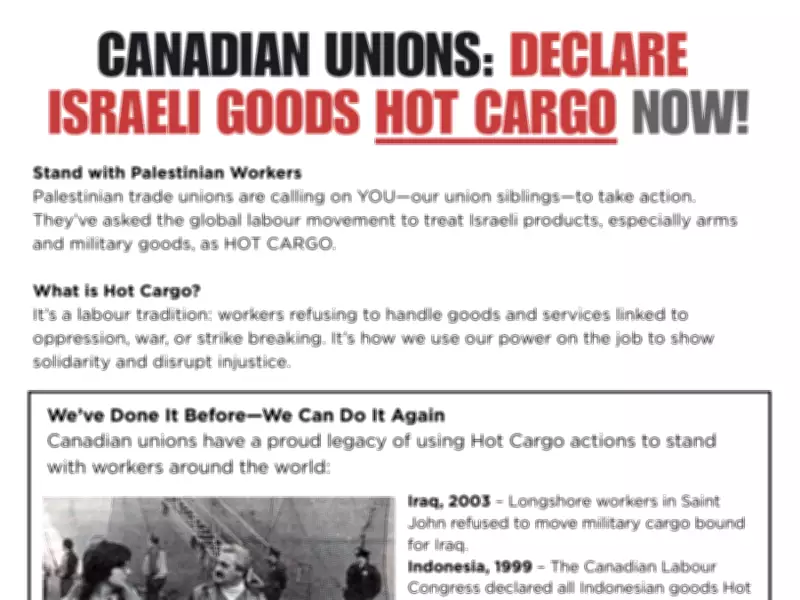
Many Canadians are already struggling with rising costs and job insecurity. Now, a radical group is pushing unionized workers to join a campaign that is likely to add even more pressure on Canadian workplaces and livelihoods, to advance a foreign political agenda.
The "hot cargo" campaign
That campaign is called "hot cargo." It is being driven by Labour for Palestine Canada (also known as Labour4Palestine and L4P), a pan-Canadian network of union activists. They are not a formal union or a registered entity, but a coalition of people and interest groups operating through coordinated messaging and actions.
"Hot cargo" began as a labour-law issue in 1949, when workers refused to handle goods tied to a labour dispute in protest of unfair treatment of their colleagues. It is a union tactic where workers refuse to handle certain goods tied to a dispute they deem unfair or morally unacceptable.

Over time, this tactic has been repurposed for broader ideological boycotts that stray far from protecting co-workers. Today, it runs against the core interests of workers and the purpose of unions themselves, seeking to drag unions into foreign boycotts.
L4P's political agenda
L4P situates itself within broader anti-imperialist and anti-Israel activism. On October 7, L4P declared "full solidarity" with Palestinians entering a "new stage of resistance." Today, L4P is pushing the Canadian Labour Congress to adopt a national "hot cargo" resolution against the State of Israel, which, according to Jeff Shantz, writing on the far-left website Media Co-op, is also meant to impose economic costs on Canada.
"Hot cargo" is anti-Canadian, runs against democratic values and is ultimately anti-worker.
Selective application
First, it is inherently selective. The same standard is not applied consistently to goods from other countries with well-documented human rights abuses. There are no comparable calls to block imports from Bangladesh, Vietnam, China, Turkey, Saudi Arabia or Mexico. Instead, the focus is placed on one country, Israel.
Divisive and economically dangerous
Second, "hot cargo" campaigns are divisive, pushing unions to spend members' dues on a polarizing foreign policy issue, instead of pressing labour and workplace issues.
Third, it is economically dangerous. At a time of uncertainty and technological change, unions should be upskilling workers, protecting jobs, and strengthening bargaining power. This campaign is likely to do the opposite: it could reduce workers' leverage and disrupt supply chains — further threatening jobs across Canada and undermining growth.
L4P's influence on unions
Despite this, L4P has had success influencing union leadership and advancing resolutions at conventions, recruiting union members, organizing and co-organizing labour movement speaker events.
L4P builds networks across unions through union caucuses, "educational" sessions, speeches at union events expanding its reach and influence over union policy. At conventions, they are given spaces to run "international solidarity" booths and distribute ideologically driven materials. They also advance boycott and divestment campaigns that target Canadian pensions, procurement and local businesses.






