Everett, Washington, May 07, 2026 (GLOBE NEWSWIRE) — Fluke Corporation today released survey findings revealing a significant acceleration in digital maturity across manufacturing, propelled by a year-over-year increase in predictive maintenance adoption. Rising investment in Generative AI (36 percent) and Industrial AI (35 percent) underscores this transition, as organizations move beyond pilot programs toward production-scale impact.
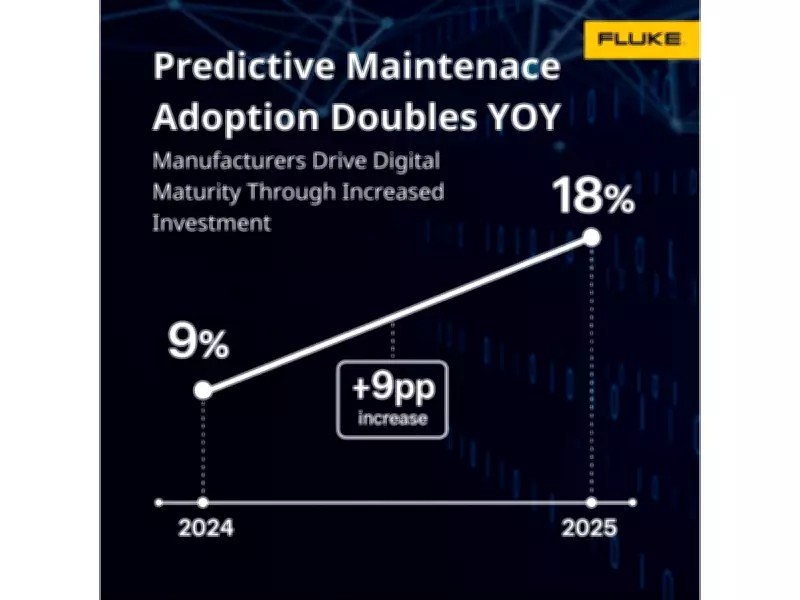
The research, conducted by Censuswide, surveyed over 600 senior decision-makers and maintenance professionals in the United States, the United Kingdom, and Germany. The findings show that within one year, reactive maintenance remained flat at 36 percent. Proactive maintenance fell from 55 percent to 45 percent, while predictive maintenance adoption doubled from 9 percent to 18 percent, signaling a shift from traditional preventive models to data-driven execution.
Increased Capital Allocation
The findings indicate this transition is being reinforced by increased capital allocation. Over the next 12 months, manufacturers are prioritizing technologies that deliver measurable operational impact quickly. The data shows a clear shift toward pragmatic investment: nearly eight in ten organizations (72 percent) now allocate 16 to 30 percent of their maintenance budgets to new technologies, with investment moving away from exploratory AI (44 percent in 2024) toward operational priorities including cybersecurity (37 percent), data management (36 percent), Generative AI (36 percent), and Industrial AI (35 percent).

Workforce Readiness Lags Behind
However, the data shows a growing disconnect between technology adoption and workforce readiness. The results point to a deeper issue, with skills-related challenges accounting for approximately 78 percent of all reported obstacles. These include lack of expertise (23 percent), knowledge shortages (18 percent), skilled labor gaps (19 percent), and broader workforce skills shortages (17 percent).
As manufacturers move from experimentation to execution, respondents show that expectations around Industry 5.0 are resetting accordingly. Confidence in near-term achievement has declined: the share expecting completion within six months fell from 33 percent to 22 percent, while 40 percent now anticipate a one- to four-year timeline.
Instead, the data suggests manufacturers are concentrating on what is achievable now. Nearly half of respondents (49 percent) plan to advance connected reliability initiatives within the next 12 months, signaling reliability as the practical bridge between near-term operational needs and longer-term Industry 5.0 ambitions.