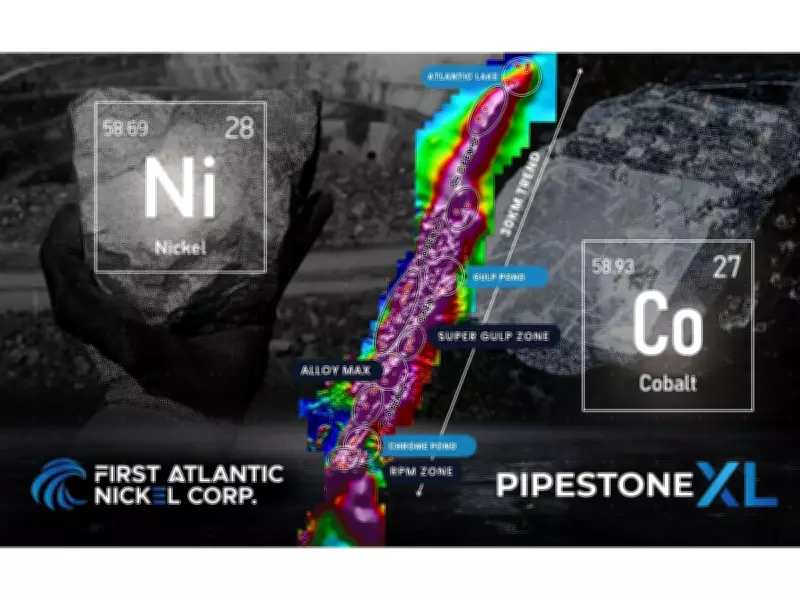
First Atlantic Nickel Corp. (TSXV: FAN | OTCQB: FANCF) has announced a name change to First Atlantic Nickel & Cobalt Corp., effective April 29, 2026. This strategic move reinforces the natural cobalt content of awaruite, a rare, naturally magnetic nickel-iron-cobalt (Ni-Fe-Co) alloy mineral with high-grade nickel content. The company's Pipestone XL project in Newfoundland hosts broad zones of widely disseminated awaruite nickel and cobalt mineralization.
Participation at SAFE Summit 2026
The company will also participate in the SAFE Summit 2026 in Washington, DC, on April 27-28, 2026, at the Walter E. Washington Convention Center. SAFE is a nonpartisan organization focused on transportation, energy, and supply chain policies that enhance U.S. economic and national security. For over two decades, SAFE has led policy discussions on energy and national security with retired four-star admirals and generals, aiming to reduce reliance on adversarial nations for critical materials and technologies.
Strategic Importance of Awaruite
The U.S. Geological Survey (USGS) has recognized awaruite's strategic potential, noting it is easier to concentrate than pentlandite, the principal nickel sulfide. Awaruite's natural magnetism allows magnetic separation to capture both nickel and cobalt in a single high-grade concentrate, suitable for direct input into EV battery chemical production or stainless-steel manufacturing. This process bypasses midstream smelting, roasting, and high-pressure acid leach circuits used in conventional nickel and cobalt processing.

Cobalt's Critical Role
Cobalt is essential for lithium-ion batteries in electric vehicles and nickel-cobalt superalloys used in jet engines, gas turbines, and aerospace applications. According to the USGS, about 51% of U.S. cobalt consumption in 2024 was for superalloys, primarily aircraft engines, with additional demand from batteries, chemicals, and medical implants. However, global cobalt supply chains are heavily concentrated. The U.S. Army War College notes that the Democratic Republic of Congo produces 80% of the world's cobalt, with Chinese state-owned enterprises controlling 80% of output. The USGS has highlighted supply risks due to China's monopoly over cobalt battery materials, especially amid rising geopolitical tensions and export restrictions on critical minerals.