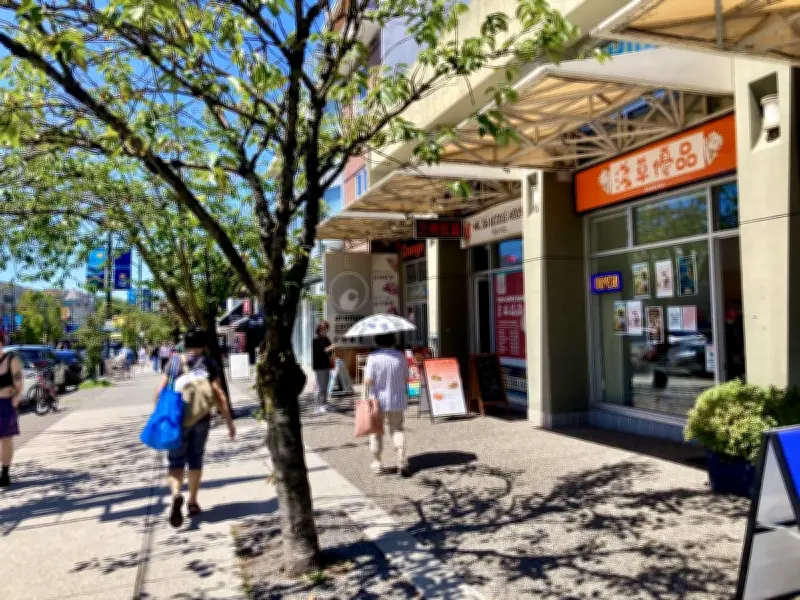
Kerrisdale Village, the bustling shopping district at 41st Avenue and West Boulevard in Vancouver, is thriving with diners, shoppers, and residents enjoying its international restaurants and long-established stores, while nearby Dunbar and West Point Grey Village struggle with vacancies. Despite similar population density and demographics among these affluent west-side neighbourhoods, Kerrisdale carries subtle secrets to its success.
Similar Densities, Different Outcomes
The number of people per square hectare in Kerrisdale is virtually the same as in Dunbar and Point Grey, and all three have among the lowest densities in the city. The demographics have also shifted similarly over the past 40 years: from predominantly European-origin residents in the 1980s to a slight majority of people of colour today, with those of Chinese extraction making up 30 to 40 per cent of residents, according to the City of Vancouver. Average detached house prices remain in the $3-million range across all three neighbourhoods.
Kerrisdale's Advantages
Veteran urban planner Lewis Silberberg, who has produced major retail reports for the City of Vancouver, points to several key differences. Kerrisdale’s retail zone is one of the oldest in the city, with stores dating back to 1912. It is also more central than Dunbar and Point Grey, which lie on Vancouver’s western edge. Crucially, Kerrisdale has 307 storefronts, compared to about 122 in Point Grey Village and 168 on Dunbar Avenue, though the latter is disadvantaged by being divided into three district zones.

One of Kerrisdale’s greatest strengths is its diverse, low-cost restaurants. As Vancouver Sun reporter Denise Ryan noted in a recent Eat Streets article, the area offers many international cuisines, especially Asian. “This is the place for food,” said Charles Gao, who was raised in Taiwan, as he sampled from Mr. Shi Noodle House on 41st. Other popular eateries include Big Way Hot Pot, Golden Ocean Seafood Restaurant, Ramen Danbo, and Baoguette Vietnamese Bistro.
Struggles in Dunbar and Point Grey
In contrast, Dunbar Avenue and Point Grey Village are peppered with vacancies. The differences may not be obvious, say experts, but they are crucial. Silberberg’s inventory highlights that Kerrisdale’s larger number of storefronts and its central location give it a competitive edge. The three neighbourhoods have virtually the lowest densities in the city, yet Kerrisdale’s older, more concentrated commercial core attracts more foot traffic and business activity.
Implications for Urban Planning
The contrasting fates of these neighbourhoods offer lessons for urban planners and policymakers. While population density and demographics are often cited as key drivers of retail success, Kerrisdale demonstrates that historical development patterns, storefront density, and a diverse restaurant scene can outweigh these factors. As Vancouver considers its 17 ‘villages’ plan, understanding why Kerrisdale thrives could help revitalize struggling commercial districts.