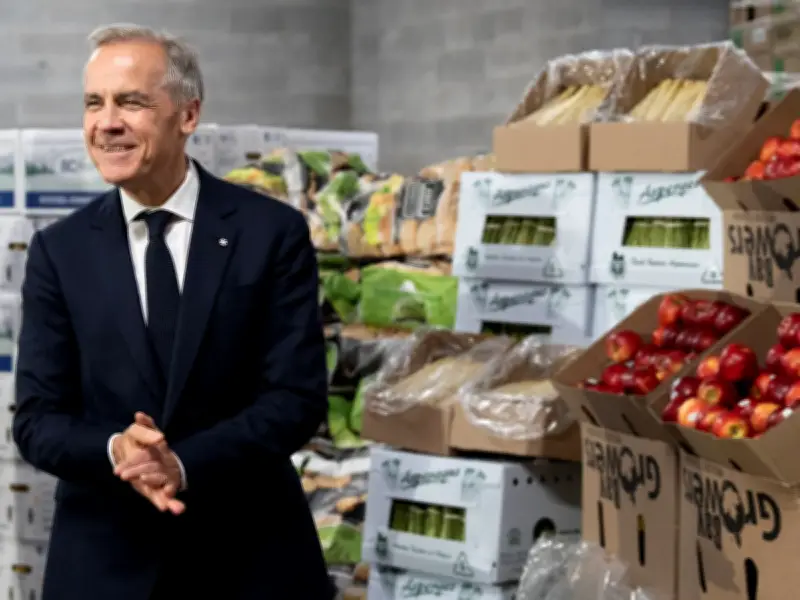
The federal government's plan to tackle rising food prices while reducing dependence on imports may be easier said than done, according to experts who say complexities in the food supply chain could make those goals hard to achieve at the same time.
The $3.2-billion National Food Security Strategy, launched on Thursday, promises to address concerns over rising food prices by improving access to locally-produced goods and increasing competition in the food retail sector. The strategy is part of Prime Minister Mark Carney’s ongoing efforts to shore up Canada’s food supply chain by reducing reliance on imports. Carney said during a news conference on Thursday that “the country’s sovereignty depends on its ability to feed, to fuel, and to defend itself,” and “over-reliance has left us vulnerable to global shocks, to conflicts, droughts, tariffs.”
Strategy Aims and Targets
The strategy did not provide overall import reduction targets, but did say it aims to increase the domestically-produced share of “healthy food” available to Canadians from 75 per cent to 85 per cent by 2032. Canada currently is heavily dependent on imports for fresh produce, with 88 per cent of fresh fruits and 72 per cent of vegetables coming from abroad.

But experts say achieving the twin goals of reducing imports and food prices at the same time may be tricky given that it will almost certainly be more costly to grow certain foods at home.
Expert Perspectives on Challenges
Michael Widener, a professor at the University of Toronto who focuses on economic geography, said greenhouses can help increase resilience in Canada’s food system and the country’s ability to produce fruits and vegetables, but it cannot be done at a scale required to reduce imports significantly. Building and maintaining greenhouses is expensive, labour intensive and energy intensive. All of this will be factored into food prices, on top of the transportation costs required to get food on grocery store shelves.
“Where we’ll have more success is food processing, where a lot of grains and things like that are produced in Canada at scale and are then exported and brought back in after they’ve been processed. I think there’s a road to bring back food production and processing systems to Canada,” he noted.
Even then, there are trade-offs. “If we want to onshore (food processing), then we are going to have to develop the networks and technologies to make sure that they’re done at a lower cost,” he said.
Michael von Massow, a food economist and professor at the University of Guelph, said while the overall strategy is a step in the right direction, it won’t immediately lower grocery prices because it will take years before the economy benefits from the infrastructure investments.
“We run the risk of disappointing Canadians if we position it as immediately lowering costs of buying food,” he said. “If I decided to build a greenhouse today, it’s going to be a while before it gets built. Greenhouses will help stabilize prices over time, but I’m not sure they’ll bring prices down. They’ll moderate some of the shocks in the system, like a short-term spike in prices because of a crop failure somewhere.”