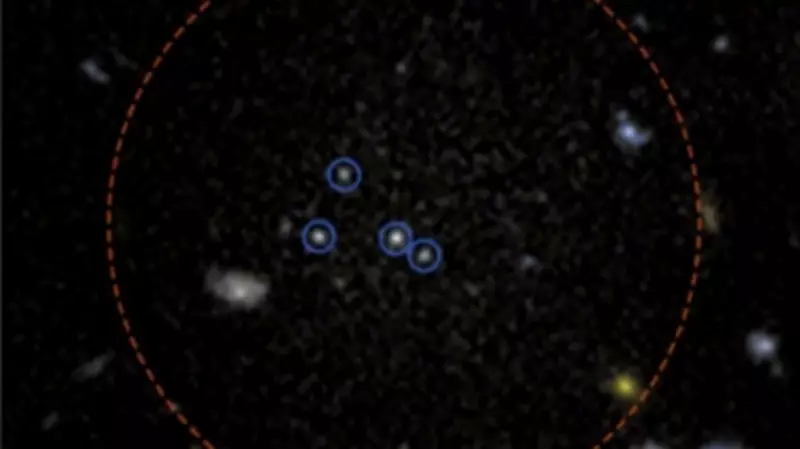
Canadian-Led Team Uncovers Elusive 'Ghost Galaxy' Dominated by Dark Matter
A groundbreaking discovery by a Canadian-led research team has revealed a nearly invisible 'ghost galaxy' that is composed almost entirely of dark matter. This finding, announced in early March 2026, sheds new light on the mysterious substance that makes up a significant portion of the universe.
Advanced Techniques Reveal Hidden Structure
The research team, which includes scientists from the University of Toronto, utilized sophisticated astronomical methods and data from NASA and the European Space Agency (ESA) to detect the galaxy. Key to this discovery were observations of four globular clusters of stars orbiting around what was suspected to be a dark galaxy. These clusters provided crucial evidence of the galaxy's presence, despite its near-invisibility in conventional telescopes.
Dark matter, which does not emit, absorb, or reflect light, has long puzzled scientists. This discovery offers a rare glimpse into how such matter can form galactic structures. The team's work involved meticulous image processing and analysis, highlighting the importance of international collaboration in space research.

Implications for Understanding the Universe
This finding has significant implications for astrophysics and cosmology. By studying this ghost galaxy, researchers hope to learn more about the properties and distribution of dark matter, which is estimated to constitute about 85% of the universe's mass. Understanding dark matter is essential for explaining the formation and evolution of galaxies, as well as the large-scale structure of the cosmos.
The discovery underscores Canada's growing role in cutting-edge space research, with contributions from institutions like the University of Toronto. It also demonstrates how technological advancements in astronomy are enabling scientists to probe deeper into the universe's mysteries.
Future Research Directions
Moving forward, the research team plans to conduct further observations to confirm the galaxy's characteristics and explore similar dark matter-dominated structures. This could involve using more powerful telescopes and developing new analytical techniques to detect other ghost galaxies.
In summary, the identification of this ghost galaxy marks a major milestone in dark matter research. It not only advances our scientific knowledge but also showcases the innovative work of Canadian researchers in the global scientific community.