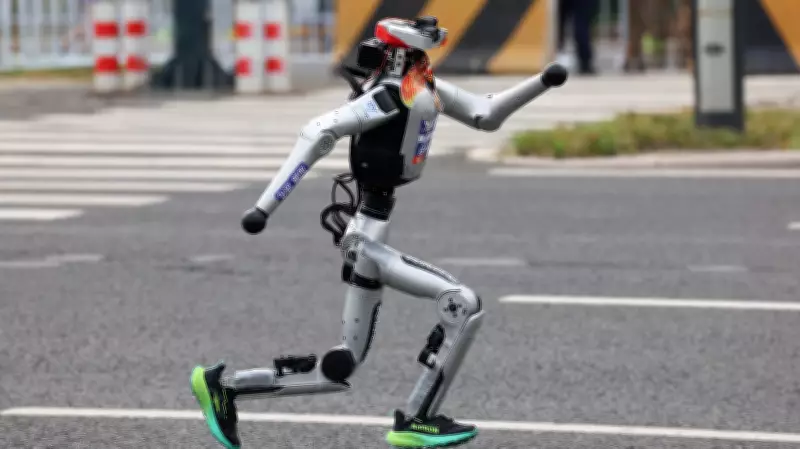
In a stunning display of technological prowess, dozens of Chinese-made humanoid robots demonstrated their fast-improving athleticism and autonomous navigation skills by whizzing past human runners in a half-marathon race in Beijing on Sunday. This event underscores the sector's rapid technical advances, marking a significant leap from last year's mishap-ridden inaugural edition.
From Mishaps to Milestones
The contrast between this year's race and last year's is stark. In the 2025 edition, most robots were unable to finish, with the champion robot recording a time of 2 hours and 40 minutes—more than double that of the human winner. This year, not only did the number of participating teams surge from 20 to over 100, but several robot frontrunners were noticeably faster than professional athletes, beating the human winners by more than 10 minutes.
Nearly half of the robot entrants navigated the tougher terrain autonomously during the 21-kilometer (13-mile) race, a significant improvement from last year when many were directed by remote control. To avoid collisions, the robots and 12,000 human runners competed on parallel tracks.

Record-Breaking Performances
The winning robot, developed by Chinese smartphone brand Honor, finished the race in an impressive 50 minutes and 26 seconds. This time is several minutes faster than the half-marathon world record set by Ugandan runner Jacob Kiplimo in Lisbon last month. Teams from Honor, a Huawei spin-off, secured all three podium spots, with their robots self-navigating and posting world-record-beating times.
Du Xiaodi, an Honor engineer on the winning team, revealed that their robot was in development for a year. It features legs 90 to 95 centimeters (35 to 37 inches) long, designed to mimic elite human runners, and incorporates liquid cooling technology used in Honor's smartphones. Du emphasized that while the sector remains in a nascent phase, he is confident humanoids will eventually reshape many industries, including manufacturing.
"Running faster may not seem meaningful at first, but it enables technology transfer, for example, into structural reliability and cooling, and eventually industrial applications," Du said.
Spectator Reactions and Future Aspirations
Spectators viewed the variety of humanoids of different sizes and gaits as evidence of China's improvements in robotics. Chu Tianqi, a 23-year-old engineering student at Beijing University of Posts and Telecommunications, expressed awe at the robots' running posture.
"The humanoid robots' running posture I saw was really quite impressive... considering that AI has only been developing for a short time, I'm already very impressed that it can achieve this level of performance," he said. Chu added that the future will be an AI era, and those resistant to it risk becoming obsolete.
Another spectator, 11-year-old schoolboy Guo Yukun, was inspired to pursue a university degree in robotics after watching the race. Guo takes regular classes in robotics theory and programming at his elite Beijing school and is part of his school's team for the International Olympiad in Informatics, a global programming competition for high schoolers.
Challenges and Economic Viability
While economically viable applications of humanoid robots mostly remain in a trial phase, the half-marathon's showcasing of these machines' physical prowess highlights their potential to reshape everything from dangerous jobs to battlefield combat. However, Chinese robotics firms are still struggling to develop the AI software needed to match the efficiency of human factory workers.
Experts noted that the skills displayed during the half-marathon, while entertaining, do not directly translate to widespread commercialization in industrial settings. Manual dexterity, real-world perception, and capabilities beyond small-scale, repetitive tasks are crucial for such applications.

China's Strategic Push in Robotics
China is actively seeking to become a global powerhouse in this frontier industry. The government has enacted a wide range of policies, from subsidies to infrastructure projects, to cultivate local firms. This push was highlighted in February during the country's most-watched TV show, the annual CCTV Spring Festival gala, which featured a lengthy martial arts demonstration. Over a dozen Unitree humanoids performed sophisticated fight sequences with swords, poles, and nunchucks in close proximity to human children performers, showcasing China's ambition to dominate humanoid robotics and the future of manufacturing.
The Beijing half-marathon serves as a vivid testament to the rapid advancements in Chinese robotics and AI, setting the stage for future innovations that could transform various sectors worldwide.