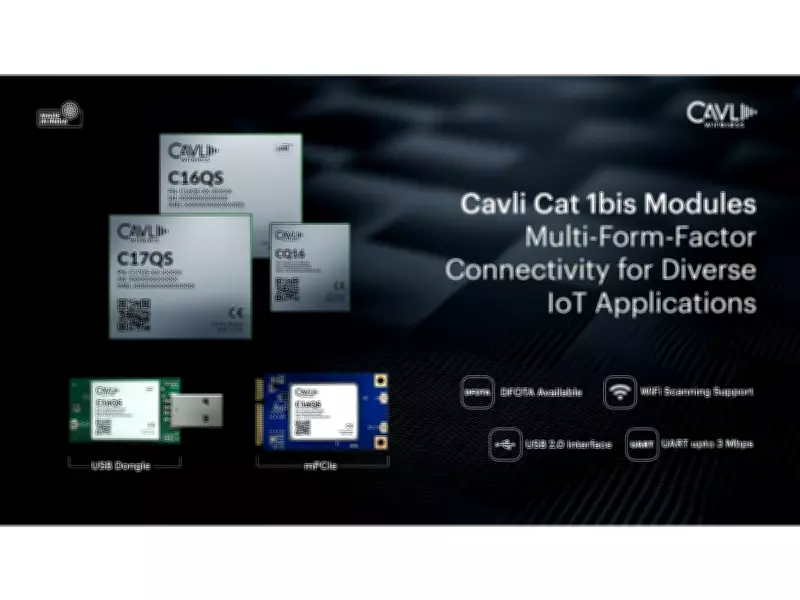
In a significant development for the Internet of Things sector, Cavli Wireless has announced the expansion of its LTE Cat 1bis portfolio with three new multi-form-factor modules. The CQ16, C16QS, and C17QS modules are engineered to provide cost-effective, power-efficient, and flexible connectivity solutions for a wide array of IoT applications across various industries.
Optimized for Scalable IoT Deployments
Designed to deliver LTE-class reliability while minimizing both cost and power consumption, this portfolio represents a strategic advancement for large-scale IoT implementations. The modules are particularly well-suited for applications such as asset tracking, smart metering, industrial monitoring, logistics operations, and smart city infrastructure projects.
Built on a common Cat 1bis foundation, these modules support downlink speeds up to 10 Mbps and uplink speeds up to 5 Mbps. They operate on FreeRTOS and are available in compact LGA and mPCIe form factors with integrated SIM options. Advanced power-saving features including eDRX, sleep, and hibernate modes enable extended battery life for long-term deployments.

Portfolio Features and Capabilities
The Cavli Wireless portfolio emphasizes several key technological advantages:
- DFOTA Support: Device Firmware Over-The-Air capabilities for remote updates
- FreeRTOS Integration: Real-time operating system support for efficient performance
- Wi-Fi Scanning: Enhanced connectivity options for hybrid network environments
- Multiple Interfaces: Versatile connectivity options for diverse hardware designs
- Cost Optimization: Simplified hardware design to reduce manufacturing expenses
Individual Module Specifications
CQ16 Module: Compact and Cost-Sensitive Solutions
The CQ16 module is specifically designed for deployments where space efficiency and cost sensitivity are paramount. Available in both LGA and mPCIe form factors, its ultra-small design enables seamless integration into highly constrained device architectures. While it doesn't include GNSS functionality, it does support Wi-Fi scanning and features dual-SIM support for network redundancy and operational flexibility in regions with variable network coverage.
C16QS Module: Enhanced Versatility and Integration
Building upon the CQ16 foundation, the C16QS module offers enhanced versatility through multiple form factors including LGA, Mini-PCIe, and USB dongle configurations. The module supports global and regional variants covering Eurasia and Japan, North America, Latin America, Australia and New Zealand, Europe, and India. Integrated eSIM simplifies global connectivity management, while optional integrated L1 GNSS support enables standard positioning capabilities for tracking and mobility applications.
C17QS Module: Advanced Performance Capabilities
Positioned as the premium offering within the portfolio, the C17QS module extends the capabilities of the C16QS to address more demanding IoT requirements. It offers up to 50% higher processing performance, 60% more RAM, and twice the ROM compared to the C16QS. The module supports iSIM technology for deeper integration and reduced component counts, while featuring advanced GNSS capabilities with dual-band L1+L5 support for improved positioning accuracy in challenging environments.
Industry Implications and Future Outlook
This expanded portfolio enables original equipment manufacturers and solution providers to build scalable, reliable, and future-ready IoT devices across multiple industries. The focus on deployment flexibility, cost optimization, and power efficiency addresses critical challenges in the IoT ecosystem, particularly for large-scale deployments where operational costs and system complexity can become significant barriers to implementation.

The modules' combination of performance characteristics and flexible form factors positions them as viable solutions for both basic connectivity needs and more advanced applications requiring precise location data and enhanced processing capabilities. As IoT adoption continues to accelerate across industrial, commercial, and municipal sectors, such technological advancements in connectivity solutions are expected to play a crucial role in enabling next-generation connected devices and systems.