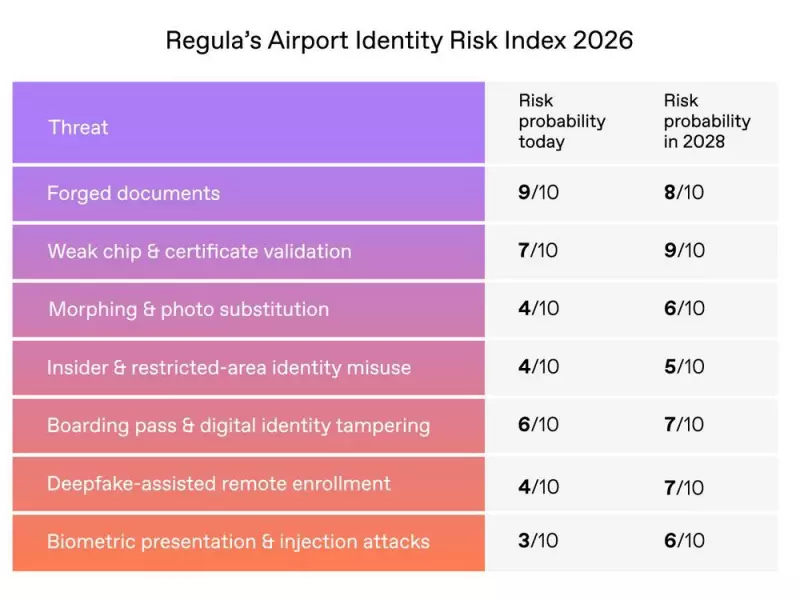
Airport Identity Risk Index 2026: Digital Vulnerabilities Outpace Traditional Threats
As global airports rapidly transition from physical documents to digital identities, replacing boarding passes with biometric authentication and manual checks with automated gates, identity verification has become both the backbone of terminal security and its most critical vulnerability point. In response to this evolving landscape, Regula, an international developer of identity verification solutions, has released its comprehensive Airport Identity Risk Index 2026.
Practice-Driven Assessment of Emerging Threats
This practice-driven assessment examines the identity threats currently facing airports worldwide and projects how these risks are expected to evolve through 2028. Built upon real-world airport deployments, the Regula report provides unique insights into how identity systems actually perform under operational pressure across multiple touchpoints including automated gates, remote enrollment workflows, biometric checkpoints, and digital travel credentials.
The index identifies which security risks currently exist, which vulnerabilities are accelerating most rapidly, and which threats are beginning to decline as technology and procedures mature within the aviation security ecosystem.

The Shifting Landscape of Airport Security Vulnerabilities
The Airport Identity Risk Index reveals a significant trend in security exposure: while traditional threats such as forged physical documents remain highly prevalent today, their relative impact is expected to decrease substantially as airports deploy more advanced scanners and automated document verification systems.
Simultaneously, identity risks associated with digital workflows are gaining alarming momentum. The report highlights several critical areas of concern:
- Inconsistent chip and certificate validation has emerged as one of the fastest-growing exposure points, particularly as electronic passports, mobile identities, and digital travel credentials increasingly rely on cryptographic trust mechanisms.
- Boarding pass and digital identity tampering remains a persistent threat as QR- and mobile-based credentials become more widespread, with weak application, scanner, or backend validation potentially allowing attackers to alter access parameters and bypass security controls.
Expert Analysis: A Fundamental Shift in Security Paradigm
Arif Mamedov, CEO of Regula Forensics, Inc., emphasizes the fundamental transformation occurring in airport security: "Airports are becoming some of the most identity-dependent environments in the world. The biggest shift we're seeing is not just new attack techniques, but a change in where identity fails. Risks are moving away from the physical checkpoint and into digital, cryptographic, and biometric layers that weren't designed to fail loudly."
Mamedov further explains: "All this implies that identity security at airports can no longer be treated as a series of isolated checks. It has to function as a continuous, multi-layered system that spans the entire passenger journey from initial booking to final boarding."
Building Resilient Identity Defense Systems
The report provides clear guidance for airports preparing for this threat evolution, recommending that security teams move beyond reliance on single control points and instead develop comprehensive, layered identity defense systems. A resilient approach should combine multiple security elements:
- Forensic-level document verification capabilities
- Complete chip and certificate authentication protocols
- Secure biometric capture with robust liveness detection
- Cryptographically protected digital identities validated against backend systems
When these security layers function cohesively, identity failures become contained rather than amplified across the entire airport security ecosystem. The Airport Identity Risk Index 2026 serves as both a warning and a roadmap for aviation security professionals navigating the complex transition from physical to digital identity verification systems.