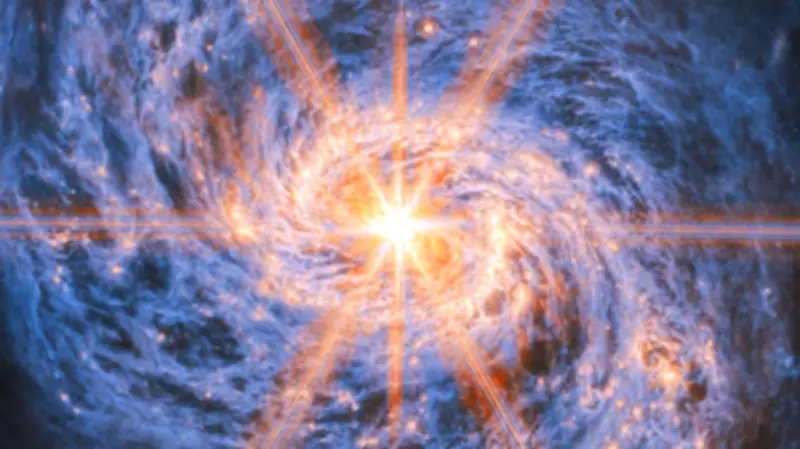
NASA's James Webb Space Telescope has delivered a stunning new image of Messier 77 (M77), a barred spiral galaxy that has long fascinated astronomers for its relative proximity and spectacular features. The image reveals the galaxy's brilliant heart in exquisite detail, showcasing the dense central region and the intricate spiral arms that define this celestial wonder.
A Cosmic Marvel in the Constellation Cetus
Located approximately 47 million light-years away in the constellation Cetus, M77 is one of the most studied galaxies in the universe. Its bright core, classified as a Seyfert galaxy, harbors an active supermassive black hole that emits intense radiation across the electromagnetic spectrum. The Webb telescope's infrared capabilities allow it to pierce through the dust and gas that obscure the galaxy's center in visible light, revealing structures previously hidden from view.
Webb's Unique Perspective
The image, captured by Webb's Near-Infrared Camera (NIRCam) and Mid-Infrared Instrument (MIRI), combines data from multiple wavelengths to create a composite that highlights both the hot, young stars in the spiral arms and the cooler, older stars in the galactic bulge. The bright core, often referred to as the galactic nucleus, shines with an intensity that outshines the rest of the galaxy, a hallmark of its active galactic nucleus (AGN).

Astronomers are particularly interested in M77 because it serves as a nearby laboratory for studying the interaction between supermassive black holes and their host galaxies. The new Webb image provides unprecedented clarity, allowing researchers to map the distribution of gas and dust in the inner regions and trace the outflow of material driven by the black hole's energy.
Scientific Significance
Messier 77 is a barred spiral galaxy, meaning it has a central bar-shaped structure composed of stars that funnels gas toward the core, fueling both star formation and the black hole's activity. Webb's observations will help scientists understand how these processes evolve over time and how they influence the galaxy's overall evolution. The image also reveals intricate filamentary structures in the spiral arms, where new stars are being born in dense clouds of gas and dust.
The Webb telescope's ability to observe in the infrared spectrum is crucial for studying galaxies like M77, where visible light is absorbed by cosmic dust. By capturing longer wavelengths, Webb can see through the obscuring material and reveal the true nature of the galaxy's heart.
A Collaboration of Space Agencies
The image is a product of the NASA/ESA/CSA James Webb Space Telescope, a collaborative effort between NASA, the European Space Agency, and the Canadian Space Agency. Launched in 2021, Webb has revolutionized our understanding of the universe, from the early cosmos to nearby planetary systems. This latest image of M77 adds to the growing catalog of Webb's breathtaking views of the universe.
For amateur astronomers, M77 is a popular target for observation, though its faint glow requires dark skies and moderate-sized telescopes. With Webb's image, the public can now appreciate the galaxy's beauty in a way that was previously impossible, highlighting the power of modern space exploration.