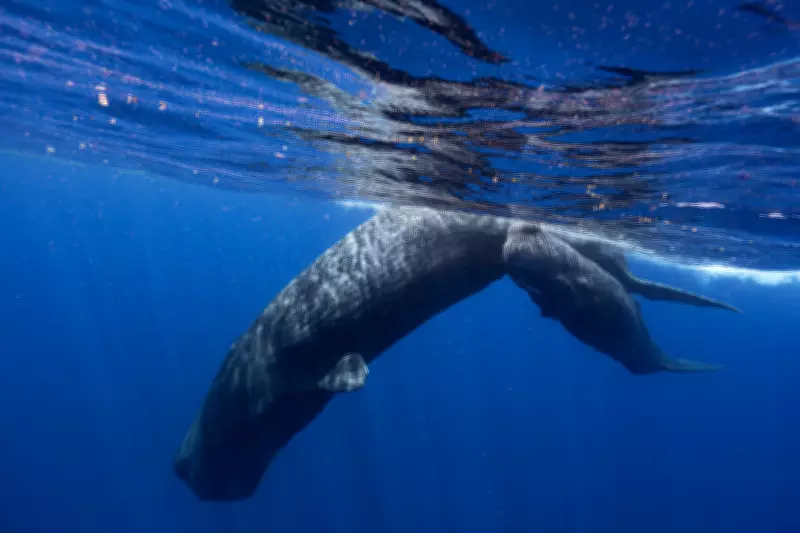
A groundbreaking study has revealed that sperm whales possess a sophisticated communication system with structural parallels to human language, challenging long-held assumptions about animal cognition and social interaction.
Decoding the Language of the Deep
Researchers analyzing vocalizations from sperm whale populations in the Caribbean have identified a complex, hierarchical organization in their clicks and codas that mirrors the syntactic and combinatorial properties of human speech. This discovery suggests these majestic marine mammals engage in nuanced social exchanges previously thought unique to humans.
Methodology and Findings
The international research team employed advanced audio recording equipment and machine learning algorithms to decode thousands of hours of sperm whale vocalizations recorded near Dominica. Their analysis revealed that whales combine discrete units of sound into structured sequences that vary meaning based on arrangement—a fundamental characteristic of human language.

Key observations include:
- Whales use repetitive click patterns (codas) with consistent rhythmic structures
- These codas demonstrate combinatorial properties where different arrangements convey distinct meanings
- Communication exhibits turn-taking dynamics similar to human conversation
- Vocalizations show regional dialects among different whale populations
Implications for Understanding Animal Intelligence
This research fundamentally expands our understanding of cetacean intelligence and social complexity. The hierarchical nature of sperm whale communication indicates these animals may possess cognitive capabilities for abstract thought, social learning, and cultural transmission previously undocumented in non-human species.
"What we're observing isn't just simple signaling," explained the study's lead researcher. "We're seeing evidence of a genuine communication system with structural depth that allows for information exchange about identity, location, social relationships, and potentially even shared experiences."
Conservation and Future Research
The findings carry significant implications for marine conservation efforts, particularly as human activities increasingly disrupt ocean acoustics. Understanding the complexity of whale communication underscores the importance of protecting their acoustic environments from shipping noise, seismic testing, and other anthropogenic disturbances.
Future research directions include:
- Developing more sophisticated translation algorithms to further decode whale communication
- Investigating whether other whale species possess similar linguistic capabilities
- Exploring how environmental changes affect whale communication patterns
- Examining the relationship between communication complexity and social structure
This study represents a paradigm shift in how scientists approach animal communication research, opening new avenues for understanding the evolution of language and intelligence across species boundaries.