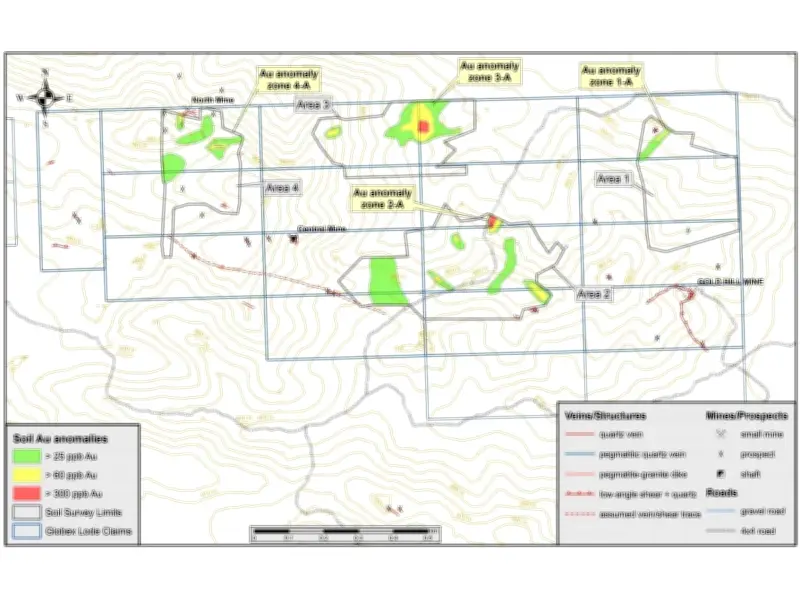
Globex Mining Enterprises Inc. has announced significant gold discoveries at its Salt Spring Gold Project in northwestern Arizona. The company reported that recent exploration efforts, including soil sampling, trenching, and channel sampling, have uncovered several new gold zones with both low and high-grade mineralization.
Project Overview
The Salt Spring Gold Project is located in Mohave County, Arizona, approximately 85 kilometers southeast of Las Vegas, Nevada. The property now consists of 57 unpatented lode claims covering a total surface area of 471.77 hectares. The main claim block was initially staked in September 2023 and expanded through additional staking in March 2025 and March 2026.
Exploration Highlights
Exploration efforts conducted from December 2025 to January 2026 have led to the discovery of several previously unrecognized gold occurrences. Key results include:

- Grab sample B-111 from anomaly 2A returned 10.73 g/t Au
- Strongly anomalous soil samples in the east block with results up to 0.9 g/t Au
- Central block soil samples with results up to 0.8 g/t Au
- New Zone 3A discovered with 16 channel and chip samples collected
- Trench TR-A returned 17.0 meters with an average weighted grade of 1.54 g/t Au
- Trench TR-C confirmed extension from TR-A, returning 7.0 meters at 0.716 g/t Au, increasing the potential width of gold mineralization
Geological Context
The project area is situated at the northernmost margin of the historic Gold Basin mining district, which extends approximately 18 kilometers north-south and 7 to 11 kilometers wide. Several major faults and lineaments crosscut the district, some of which may be directly related to gold mineralization. Gold mineralization is not evenly distributed but is restricted to distinct gold corridors.
In the northern Gold Basin district, gold mineralization is confined to an east-west trending corridor approximately 7 kilometers long and 0.4 to 1 kilometer wide. Globex's Salt Spring Property covers this northern gold corridor, which contains numerous historic exploration workings, including 22 small-scale mines and at least 70 prospects and cuts.
Historic Gold Hill Mine
The largest historic mine in the area is the Gold Hill Mine, located in the East claim block. It produced high-grade gold ore intermittently between 1930 and 1942. While no comprehensive production records exist, one note reports 359.57 tonnes averaging 21.7 g/t Au in 1940.
Mineralization Style
Gold in the district occurs in narrow, partly high-grade mesothermal quartz-carbonate veins, but the bulk is low-grade hosted in stockwork and disseminated zones. Gold deposition is believed to have occurred in a mesothermal intrusion-related environment linked to Cretaceous granitoids, with possible Miocene hydrothermal overprint from epithermal or brine sources.