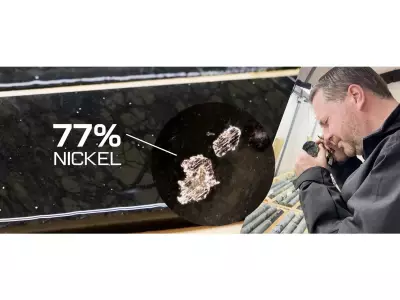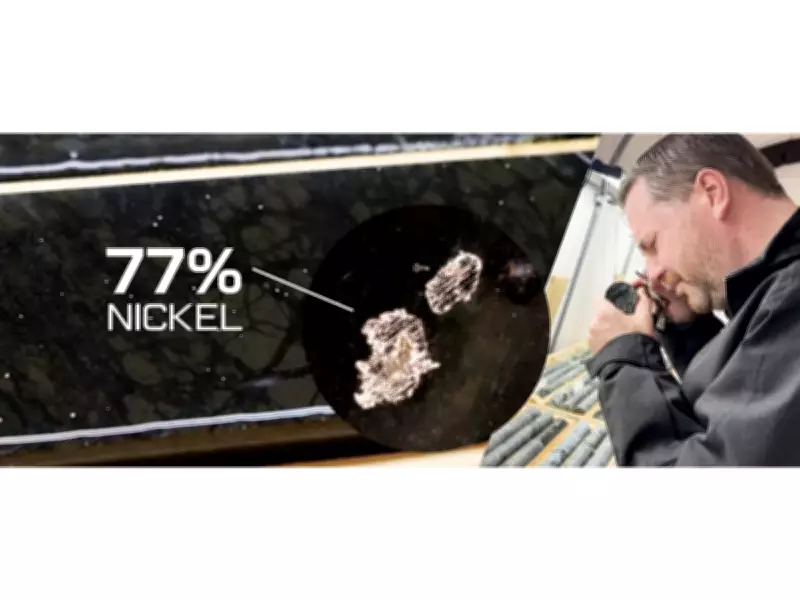
First Atlantic Nickel & Cobalt Corp. (TSXV: FAN | OTCQB: FANCF | FSE: P21) has announced that electron microprobe analysis conducted by SGS Canada in Lakefield, Ontario, has confirmed high-grade nickel and cobalt content in awaruite mineralization at the RPM Zone of its wholly owned Pipestone XL Project. The analysis, part of the company's ongoing metallurgical program, revealed that awaruite (Ni3Fe) averages 77.62% nickel and 1.69% cobalt, with peak grades reaching 86.68% nickel and 6.05% cobalt. These results are based on 33 microprobe analyses of a master composite sample comprising 32 individual samples over 96 meters of drill core from hole AN-24-02 (258 m to 354 m).
Chromite and Brucite Findings
The analysis also determined that chromium at the RPM Zone is hosted in chromite grading 60.2% Cr2O3. Given this high grade, the company is evaluating potential metallurgical processes to separate, concentrate, and process chromite. Additionally, the master composite contains an average of 5.49% brucite (Mg(OH)2), a reactive mineral capable of capturing and mineralizing atmospheric CO2. Brucite-driven carbon capture has been demonstrated at BHP's Mount Keith Nickel mine in Western Australia, which contains approximately 2.5% brucite and reportedly captures about 40,000 tonnes of CO2 from the atmosphere each year.
Awaruite Advantages
Awaruite is a naturally occurring, highly magnetic, sulfur-free nickel-iron-cobalt alloy formed through serpentinization, a geological process where hydrogen generated from ultramafic rock alteration reduces nickel and iron into native metallic form. Its strong magnetism and hydrophobic metallic surface make it ideal for concentration via magnetic separation and flotation. Unlike nickel sulfide or laterite minerals, awaruite requires no smelting, roasting, or acid leaching to reduce the mineral to metal.

The U.S. Geological Survey (USGS) acknowledged awaruite's processing advantage in its 2012 Annual Nickel Report, noting it is "much easier to concentrate than pentlandite, the principal sulfide of nickel." Conventional midstream processing for nickel sulfide and laterite sources is capital-intensive, energy-intensive, and increasingly difficult to permit, with limited smelting capacity remaining in North America and growing exposure to sulfuric acid supply chain disruption.
Potential for Direct-to-Market Concentrate
The Pipestone XL awaruite discovery has the potential to deliver a large-scale source of nickel and cobalt through onshore, mine-to-metal processing into downstream stainless steel, EV battery, and specialty alloy industries, bypassing midstream processing constraints. Awaruite can be concentrated into a high-grade nickel-cobalt product for direct feed into the stainless-steel industry or further refining into battery-grade nickel and cobalt for the electric vehicle battery supply chain. The concentrate is a potential feed for planned Canadian and US refineries, and at US facilities could help produce qualifying nickel as defined in Section 45X(c)(6) of the U.S. Advanced Manufacturing Production Credit.
Drilling Underway at Alloy Max
The company anticipates further updates from its metallurgical program, including development of a high-grade nickel-cobalt concentrate incorporating magnetic separation and flotation, as well as from the drill program underway at the Alloy Max North and Alloy Max South Zones.
For further information, questions, or investor inquiries, please contact Rob Guzman at First Atlantic by phone at +1-844-592-6337 or via email at rob@fanickel.com.