ZetaChain 2.0 Launches With Anuma AI Interface Featuring Private Memory Layer
SAN FRANCISCO — ZetaChain has announced the beta launch and public waitlist for Anuma, a privacy-first artificial intelligence interface built on the newly introduced ZetaChain 2.0 platform. This significant development represents a major advancement in AI interoperability, designed specifically to help developers create applications and agents that function seamlessly across multiple AI models while preserving private user context.
Bringing Privacy-First Principles to AI
The launch draws inspiration from privacy-first browsing experiences that have become mainstream in recent years. Ankur Nandwani, a ZetaChain Core Contributor who previously co-created the Basic Attention Token powering the Brave browser ecosystem, explained the philosophy behind this new approach. "Anuma applies that same 'privacy and user control by default' approach to the next major consumer interface of AI," Nandwani stated, emphasizing how context and memory increasingly define user experience in artificial intelligence applications.
With over 100 million monthly active users on the Brave browser platform, the team brings substantial experience in creating privacy-focused technologies that prioritize user control over data and tracking mechanisms.

Addressing AI Ecosystem Fragmentation
The timing of this launch comes as AI adoption accelerates at internet scale, yet significant fragmentation persists within the ecosystem. According to industry analysis, only 9% of consumers currently pay for more than one AI subscription across major assistants, creating what developers describe as "lock-in at the model layer."
This fragmentation forces developers to repeatedly rebuild the same integration, routing, state, and billing infrastructure while privacy and data routinely get shared across applications, agents, and model providers without adequate user control.
Core Components of ZetaChain 2.0
The new platform consists of two fundamental components designed to address these challenges:
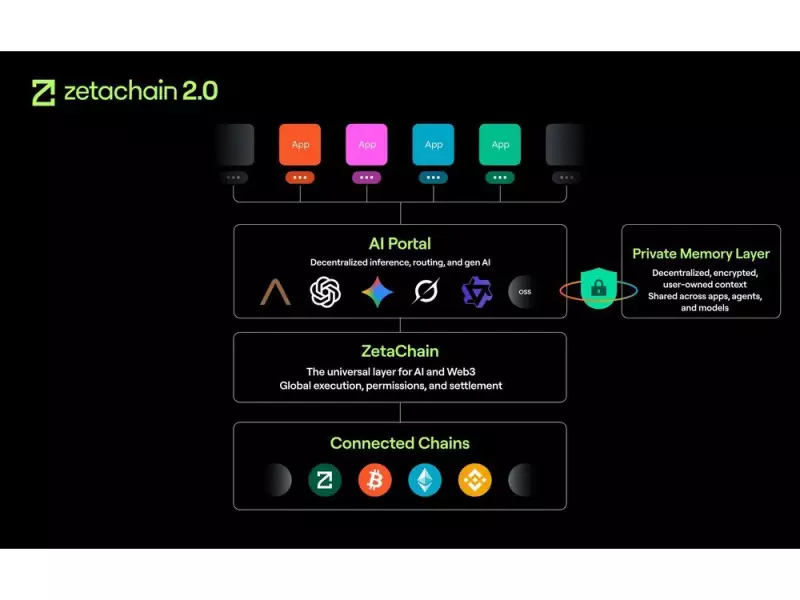
- AI Portal: A unified routing and execution layer that enables applications to access multiple AI model providers without vendor lock-in. This system includes built-in support for availability, fallback mechanisms, and cost-performance optimization.
- Private Memory Layer: A protocol-level memory system specifically designed to keep user context encrypted and permissioned. This technology enables persistent experiences across sessions while maintaining user control over what applications and agents can access.
Developer Tools and Platform Scalability
ZetaChain 2.0 has been engineered to scale as a comprehensive developer platform. Alongside the protocol components, ZetaChain is releasing a developer SDK that packages private persistent memory, cross-model interoperability, and monetization primitives into a single toolkit.
The objective is to streamline the development process for privacy-first applications and agents that can:
- Maintain continuity across user sessions
- Connect to multiple AI model providers simultaneously
- Support global monetization rails from onchain settlement to traditional payment processors
This approach eliminates the need for development teams to build bespoke infrastructure for these fundamental capabilities.
Building on Web3 Success
ZetaChain was originally created to address fragmentation challenges in Web3 by enabling universal applications that could natively access assets like Bitcoin and execute across multiple blockchains through a single platform. In 2025, the ZetaChain network demonstrated impressive scalability, growing to more than 11.5 million users and processing over 225 million transactions.
With ZetaChain 2.0, the company is extending this unification thesis to artificial intelligence, allowing applications to operate across both blockchain networks and AI models with built-in permissions and private context management.
The public waitlist for Anuma is now open as the platform enters its beta testing phase, marking what developers describe as a significant step toward more integrated, privacy-conscious artificial intelligence ecosystems.