Doomsday Clock Advances to 85 Seconds to Midnight, Signaling Unprecedented Global Peril
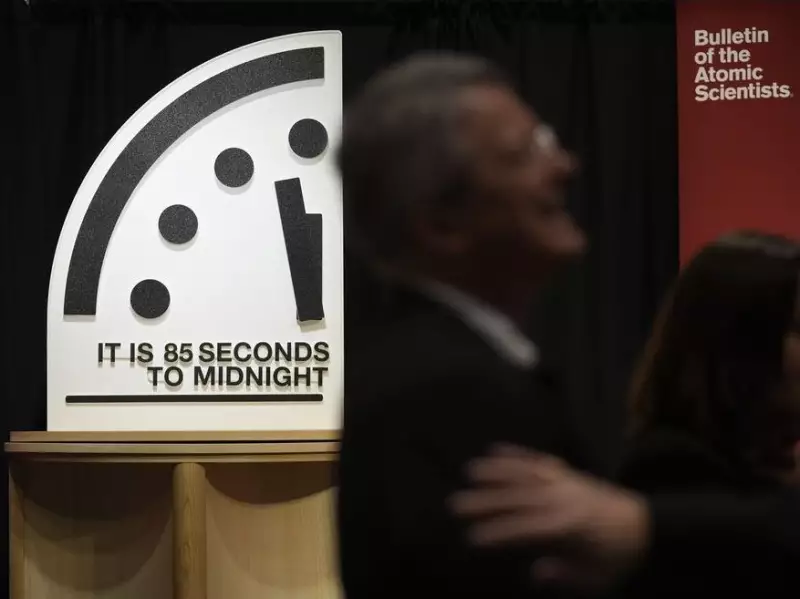
The symbolic Doomsday Clock, maintained by the Bulletin of the Atomic Scientists, has been set to 85 seconds to midnight, marking the closest humanity has ever been to global catastrophe according to the organization's assessment. This adjustment, announced in January 2026, represents a movement of four seconds closer to midnight compared to the previous year's setting.
Multiple Existential Threats Drive Clock Adjustment
The Science and Security Board (SASB), composed of 17 experts including eight Nobel Laureates specializing in nuclear risk, climate science, and disruptive technologies, identified several converging factors necessitating this alarming adjustment. "The dangerous trends in nuclear risk, climate change, disruptive technologies like AI, and biosecurity are accompanied by another frightening development: the rise of nationalistic autocracies in countries around the world," stated SASB chair Daniel Holz, a University of Chicago professor.
Key factors influencing the decision include:

- The impending expiration of the nuclear arms control treaty between the United States and Russia in late February 2026
- Escalating geopolitical tensions with major powers becoming "increasingly aggressive, adversarial, and nationalistic"
- Inadequate international frameworks governing artificial intelligence development and deployment
- Growing biological threats requiring multilateral cooperation
- Accelerating climate change impacts without sufficient global mitigation efforts
Information Warfare Complicates Global Cooperation
Maria Ressa, 2021 Nobel Peace Prize Laureate and co-founder of Rappler, emphasized the critical role of information integrity in addressing these global challenges. "Without facts, there is no truth. Without truth, there is no trust. And without these, the radical collaboration this moment demands is impossible," Ressa warned. She described an "information Armageddon" being spread by "predatory technology" that profits from misinformation, noting that falsehoods now spread more rapidly than verifiable facts.
"We cannot solve problems we cannot agree exist," Ressa continued. "We cannot cooperate across borders when we cannot even share the same facts. Nuclear threats, climate collapse, AI risks: none can be addressed without first rebuilding our shared reality. The clock is ticking."
Scientific Community Calls for Urgent Action
The Bulletin's Science and Security Board issued specific recommendations for mitigating these existential threats:
- Immediate diplomatic efforts to limit nuclear arsenals and renew arms control agreements
- Development of international guidelines governing artificial intelligence development and deployment
- Creation of multilateral agreements addressing global biological threats and pandemic preparedness
- Enhanced international cooperation on climate change mitigation and adaptation strategies
The organization warned that powerful nations are actively "undermining the international cooperation critical to reducing global risks," with Russia, China, and the United States specifically mentioned as contributing to this concerning trend.
Critics Question Clock's Methodology and Relevance
Despite its prominent symbolic status, the Doomsday Clock faces criticism from some quarters regarding its methodology and contemporary relevance. Created in 1947 following World War II, the clock has been criticized for lacking transparent criteria for its adjustments.
"Without a clear understanding of how each new time is being chosen, it becomes difficult to trust the clock's verdict or to properly understand it," argued Blane Aitchison in The Oxford Student newspaper.
Christopher Combs, a professor at the University of Texas at San Antonio, described the clock as "far too arbitrary and alarmist" to maintain meaningful credibility. "Acting like we're closer to apocalypse now than during the Cuban Missile Crisis is just silly," Combs wrote on social media platform X. "They jumped the shark a long time ago which caused the scale to lose all meaning and granularity."

Some observers have noted perceived political patterns in the clock's movements, with one commentator suggesting it "moves closer to midnight when a Republican is elected U.S. president and falls back when a Democrat comes to power." Another critic characterized the Doomsday Clock as "great marketing but terrible metrics," describing it as a "vibes-based gauge of global risk, not a model."
Despite these criticisms, the Bulletin of the Atomic Scientists maintains that the Doomsday Clock serves as a crucial symbolic reminder of humanity's capacity for self-destruction and the urgent need for international cooperation across multiple threat domains. The organization emphasizes that the clock's movement reflects expert consensus about deteriorating global conditions rather than precise scientific measurements.