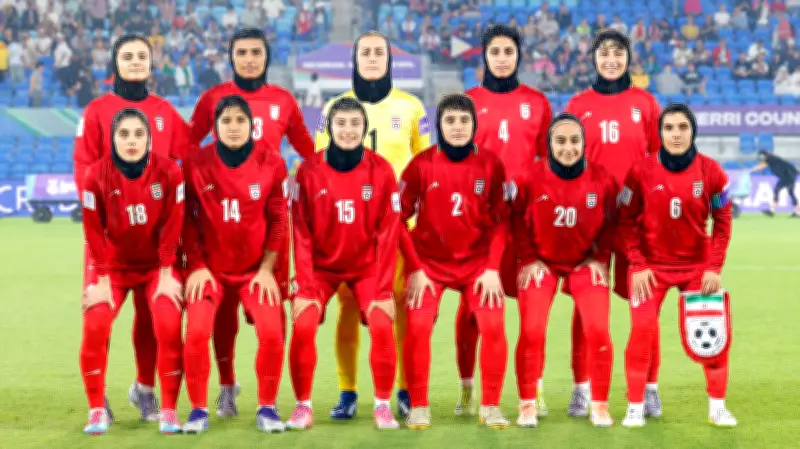
The global football players' union FIFPRO has raised alarm over the welfare of the Iranian women's national soccer team, as the athletes prepare to return home following their controversial participation in the Asian Cup in Australia. The team faced severe backlash, including being branded "wartime traitors" by Iranian state media, after they refused to sing their national anthem before a match.
Anthem Silence Sparks Outrage and Safety Fears
The Iranian team's campaign in the Australian-hosted tournament began last weekend, coinciding with U.S. and Israeli air strikes on Iran that resulted in the death of Supreme Leader Ali Khamenei. During their first match against South Korea, the players stood in silence during Iran's anthem, an act that a commentator on Islamic Republic of Iran Broadcasting described as the "pinnacle of dishonor."
Presenter Mohammad Reza Shahbazi emphasized that "traitors during wartime must be dealt with more severely," escalating concerns for the team's safety upon their return. In a subsequent match against Australia, the team sang the anthem and saluted, leading human rights campaigners to fear possible coercion by government minders.

Elimination and Fan Protests
The team was eliminated from the tournament on Sunday after a 2-0 loss to the Philippines. Post-match, fans waved the pre-1979 Iranian flag, booed the national anthem, and attempted to block the team coach from leaving, chanting "Save our girls!" in a show of solidarity amid growing safety apprehensions.
More than 66,000 people have signed a petition urging the Australian government to ensure the players, currently on the Gold Coast in Queensland, do not depart "while credible fears for their safety remain."
FIFPRO's Efforts and Communication Challenges
Beau Busch, FIFPRO president for Asia and Oceania, revealed that the union has been unable to contact the players to discuss potential asylum options in Australia. "The reality at the moment is that we're unable to get in touch with the players. That's incredibly concerning," Busch told reporters. He noted that communication issues have persisted since repression intensified in Iran earlier this year.
Busch stated that FIFPRO is collaborating with FIFA, the Asian Football Confederation, and the Australian government to apply pressure to protect the players and provide them with "agency around what happens next." He acknowledged the complexity of the situation, suggesting that some players may wish to return home, while others might seek asylum.
Coaching and Government Responses
Iran coach Marziyeh Jafari has expressed the team's eagerness to return home, saying, "We are very impatiently waiting to return," during a post-match press conference. However, most airspace in the Middle East remains closed due to ongoing conflict, complicating travel plans.
When questioned about potential asylum for the players, Matt Thistlethwaite, Australia's assistant minister for foreign affairs and trade, declined to comment on individual cases for privacy reasons. He emphasized that visa applicants must meet standard conditions, without providing specifics.
The situation highlights the intersection of sports, politics, and human rights, with the Iranian women's soccer team caught in a precarious position as international bodies rally to ensure their safety amid escalating tensions.