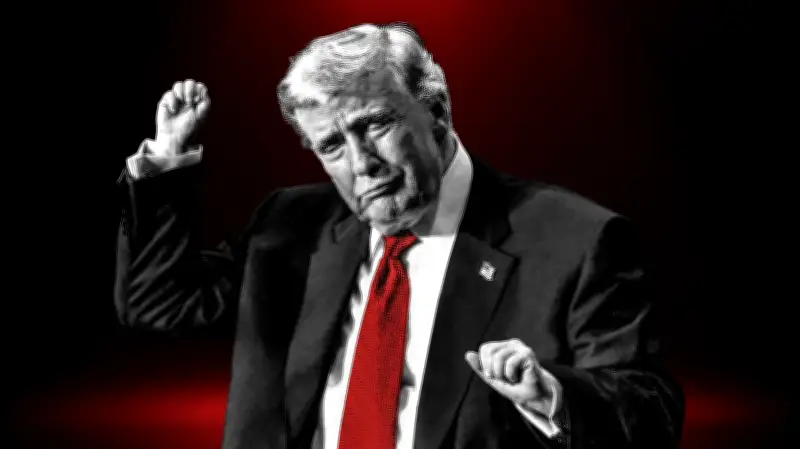
For years, President Donald Trump has performed a signature dance move at events and campaign rallies, jerking his bent arms and clenched fists forward and backward, often to the Village People's 'YMCA.' This move has become a staple of his onstage presence and part of his brand, according to body language experts.
Repetitive and Simple Moves
Patti Wood, a body language expert and author of 'Snap: Making the Most of First Impressions, Body Language, and Charisma,' noted that Trump's dance is consistent: 'It’s typically the same exact song and it’s the same exact set of moves, and he’s typically doing it when he’s wearing the blue suit, the white shirt and the red tie, so it’s part of his brand.' She added that observers watch repeatedly to understand the meaning behind the predictable actions.
Clinical psychologist Denise Dudley described the dance as a 'visual version' of Trump's speech patterns: 'If we think about it a certain way, he dances like he talks. It’s super repetitive, it’s really simple. I mean, it’s not complicated at all.'

Clenched Fists Signal Aggression
A key element of Trump's dance is his clenched fists, which experts say convey dominance and aggression. Wood explained, 'When we see somebody with their hands in fists, it creates tension in our central nervous system.' Dudley added, 'Those balled-up fists ... the gestures are super dominance-oriented, they’re aggressive.'
Wood noted that fists are instinctively perceived as weapons, keeping audiences on edge. They metaphorically mean 'fight' and communicate 'I’m cool, alpha.' This contrasts with typical dancing, where open hands invite relaxation and emotional expression. Dudley said, 'It’s just a power move to have clenched fists like that, it’s like a victory gesture rather than social dancing.'
Crowd Signaling Through Dance
Experts view Trump's dance as a form of 'crowd signaling,' where a leader encourages mimicry. Dudley explained, 'His dancing isn’t so much dancing as it is crowd signaling,' noting that humans naturally mirror gestures, vocal patterns, and movements. This phenomenon occurs at sporting events during cheers or waves.
Dudley added, 'That crowd signaling is a way that a leader can get people to start doing what it is they’re doing.' The simplicity of Trump's dance—fists and arm movements—makes it easy for supporters to replicate. 'All of his MAGA people, his constituents, they can all do that same thing. I just really see this as another way that he is signaling the crowds to “do what I do.”'
Feet Stay Planted
Trump's feet rarely move during his dance, which is unusual for onstage performances. Wood said, 'The feet are the most honest part of the body, so that’s [what] gives you the greatest revelation.' Typically, dancers shift their feet for balance and expression, but Trump remains stationary. 'He might lean to the left or lean to the right, but he’s not picking up his feet, he’s not moving through space, he’s not moving to the front of the stage or moving down to the side of the stage,' Wood observed.
This lack of movement contrasts with performers who engage the audience by moving around. Wood noted, 'A performer would want to either look to different parts of the audience or move to the front of the stage or move side to side to get more of the energy, give more of their energy.'
Facial Expressions: Grimaces and Smirks
Trump's facial expressions during his dance are also telling. Wood described a frequent grimace with lips tightly held together, as if exerting effort. 'He’s often grimacing as if he’s exerting enormous amounts of effort just to do this, as if he knows he has to,' she said. Occasionally, he smirks, possibly to 'look cool' or feign disinterest. However, Wood added, 'because the brows go down more, the eyes go clenched in, it just appears that he’s doing this with extreme effort and he doesn’t feel joyful about it.'

Dudley noted that squinting can be a victory gesture or dominant expression. To understand the emotional impact, Wood suggested trying the dance: 'Sometimes, when I’m trying to get people to understand somebody’s non-verbal behavior, I say, “Well, do that movement ... and see how you feel in your body to figure out that person or figure out how they’re feeling.”' She said those who mimic the dance feel negativity, unease, and effort, rather than the freed emotions of typical dancing.
A Peek Into Trump's Psyche
While one dance cannot fully reveal Trump's psychology, his repetitive movements offer insight. Wood concluded, 'Our body language reflects our emotional state, but the opposite is also true. We crave to understand him, to try to figure him out.'