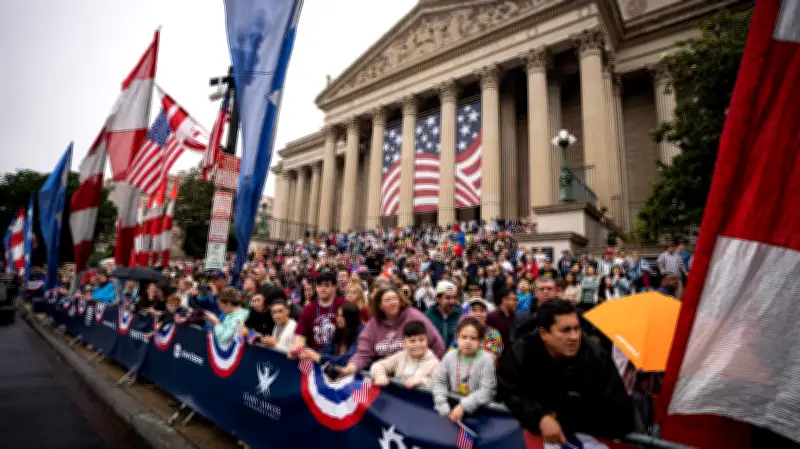
A new Reuters/Ipsos poll of 1,500 U.S. adults finds that opinions about honoring the nation's 250th birthday are sharply split across party lines. For Republican respondents, the semiquincentennial is a reason to celebrate the nation's founding, with most agreeing that observing the anniversary is important and patriotic. Democrats, however, are more likely to express ambivalence and believe that events have become too political.
Under President Donald Trump, programming for the 250th anniversary has aligned with his administration. After his reelection, Trump formed Freedom 250, a rival organization to the bipartisan America 250 group founded by Congress. Freedom 250 has been mired in partisan controversies, including a Great American State Fair from which performers have dropped out, citing its 'misleading' partisan nature, and history exhibits accused of sanitizing stories related to America's founding. Trump later said he would throw a 'spectacular' rally on the anniversary.
Partisan Differences in Celebration Plans
Ryan, an Ohio-based Democrat who asked not to share his full name, plans to sit out America 250 events. He has a U.S. flag in front of his house but does not plan to put up an 'America 250' flag, which he sees as too MAGA-coded. 'I feel like anything associated with that is an endorsement of the administration,' Ryan said. 'I just don't feel very proud right now as an American, and I don't think that's unpatriotic to say.'

The poll also reveals a divide in how Americans plan to dress for the Fourth of July. An estimated 52% of Republicans said they would wear red, white, and blue, while only 20% of Democrats said the same. For some Democrats, flag-themed attire is now seen as MAGA-coded. 'I do a side-eye every time I see something that is overly flagged up,' Ryan said.
Not all liberals feel this way. Political commentator Suzanne Lambert, known as 'the Regina George liberal,' said she will wear flag memorabilia and hit the Old Navy Fourth of July T-shirt sale. For Lambert, 'America 250 and celebrating the Fourth of July is antithetical to the MAGA movement' because it recognizes that 'we came over here because we didn't want to be ruled by kings' and 'we have a president leading the MAGA movement who wants to be a king.'
Historian Suggests Alternative Celebrations
Princeton University historian Eddie S. Glaude Jr., author of 'America, U.S.A.: How Race Shadows the Nation's Anniversaries,' said that how one chooses to celebrate the Fourth of July can be MAGA-coded depending on location, as some celebrations support Trump and the idea that 'America's perfection was secured in its founding.' Glaude argues that America suffers a 'divided soul' since its founding, imagining itself as both a beacon of freedom and a white republic.
Glaude urges Americans not to cede the Fourth of July to MAGA supporters. 'They're wrapping themselves in the flag, they're wrapping themselves in patriotism. Well, we need to wrap ourselves in the people,' he said. He cites the People's Bicentennial Commission movement in 1976 as an example of counter-programming, which responded to the corporate takeover of the country and rooted celebrations in working people.
Instead of waving an America 250 flag, Ryan plans to attend Northside, an alternative Fourth of July parade in Cincinnati that supports LGBTQ+ rights and ending Immigration and Customs Enforcement. Ryan likes that it's 'more community-based. It's not saying America is the greatest.' Glaude suggests looking toward the future: 'What MAGA has is nostalgia for a world that's long gone. What we need to do is embrace who we are in light of a future we want.'
Glaude encourages celebrating the Fourth of July in various ways, from joyful cookouts to protests. He hopes LGBTQ+, Black, and brown people celebrate their culture and show up in large numbers, because 'the power of the country rests with the people.'