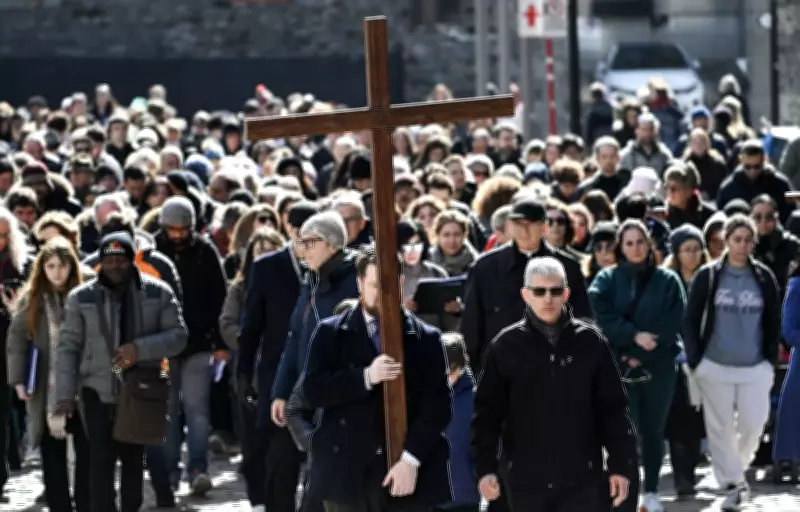
Quebec's Secularism Legislation Creates Uncertainty for Good Friday Religious Processions
The implementation of Quebec's secularism law, known as Bill 21, is generating significant apprehension among religious communities as traditional Way of the Cross marches approach on Good Friday. These annual processions, which commemorate the crucifixion of Jesus Christ through public reenactments, now face potential restrictions under the province's legislation that limits religious symbols in certain public sector contexts.
Historical Tradition Meets Modern Legislation
Way of the Cross processions have been a fixture of Good Friday observances in Quebec for generations, particularly in Montreal where participants walk through streets while praying at stations representing events from Jesus's final hours. The marches typically involve clergy wearing religious vestments and laypeople carrying crosses and religious icons through public thoroughfares.
The secularism law, passed in 2019, prohibits certain public sector employees in positions of authority from wearing religious symbols while performing their duties. While the legislation primarily targets teachers, police officers, judges, and other government workers, its broader implications for public religious expression have created a climate of uncertainty for community-organized events like the Way of the Cross marches.

Legal Ambiguity Surrounds Public Processions
Legal experts note that the law's application to temporary, community-organized religious events remains ambiguous. The legislation specifically addresses individuals in official government roles rather than participants in religious ceremonies, but some municipalities have become increasingly cautious about permitting religious displays in public spaces.
"There's genuine concern among religious communities about how broadly the secularism principles might be interpreted," explained constitutional law professor Marie-Claude Gervais. "While the law doesn't explicitly ban religious processions, it has created an atmosphere where some public officials are hesitant to approve traditional religious events that were previously uncontroversial."
Community Response and Adaptation
Religious leaders in Quebec have been consulting with legal advisors and municipal officials to ensure their Good Friday observances comply with current regulations. Some parishes have considered modifying their processions by:
- Limiting the participation of public sector employees in religious vestments
- Securing explicit municipal permits for procession routes
- Focusing processions on church properties rather than public streets
- Emphasizing the cultural rather than exclusively religious aspects of the tradition
Montreal Archbishop Christian Lépine has emphasized that the Way of the Cross represents both religious devotion and cultural heritage for Quebec's Catholic community. "These processions have been part of our shared history for centuries," he stated. "They represent peaceful expression of faith that respects all citizens while maintaining important traditions."
Broader Implications for Religious Expression
The situation highlights ongoing tensions between Quebec's commitment to secularism and the preservation of religious traditions in the public sphere. As the province continues to implement its secularism framework, religious communities across Quebec are watching how municipalities handle the Good Friday processions as a potential indicator of how other religious observances might be affected in the future.
The debate extends beyond Catholic traditions to potentially impact other religious communities whose practices involve public expressions of faith. Muslim, Jewish, and Sikh leaders have expressed concern that restrictive interpretations of the secularism law could affect their own religious observances that occur in public spaces.
As Good Friday approaches, Quebec finds itself at a crossroads between legislative principles and cultural traditions, with the Way of the Cross marches serving as a visible test case for how the province will balance these competing values in practice.