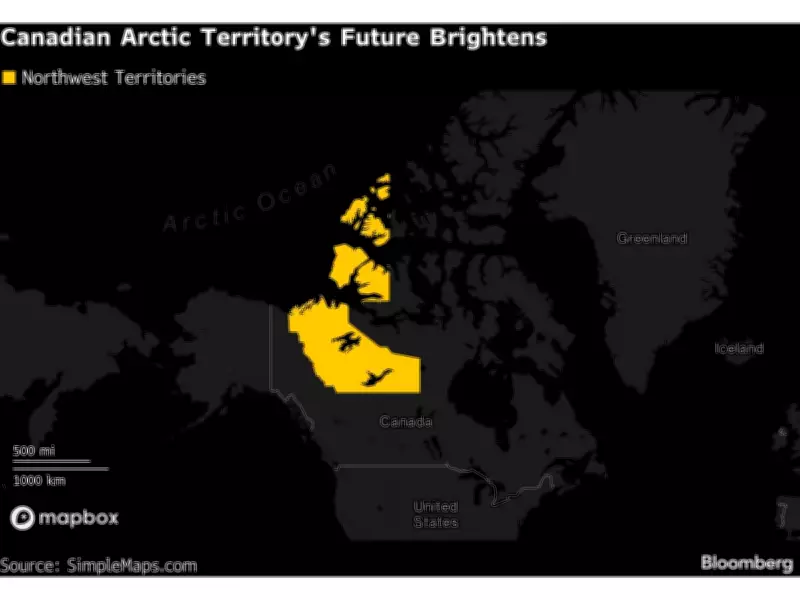
Northwest Territories Premier Sees Economic Revival Amid Arctic Focus
Canada's sudden strategic emphasis on Arctic security and natural resource development has arrived at a pivotal moment for Premier R.J. Simpson and the Northwest Territories. The far northern region, home to approximately 45,000 residents, is witnessing a rapid decline in its traditional economic pillars, yet Simpson remains optimistic about an impending turnaround.
Decline of Traditional Industries
The territory's economy faces significant challenges as its key sectors contract. Diamond mining, which represents the largest segment of the regional economy, is in steep decline. Rio Tinto Group closed its Diavik diamond mine this month, while Burgundy Diamond Mines Ltd. laid off several hundred workers after halting part of its Ekati operations last year. Additionally, oil production is set to cease with Imperial Oil Ltd. announcing plans to shutter its century-old Norman Wells operation later this year.
"We've got the diamond mines winding down, Norman Wells down, and now people are saying, well, now what?" Simpson remarked in a video interview. "Now they can see what is next and there's something big on the horizon."

New Opportunities on the Horizon
Despite these setbacks, Simpson identifies several factors driving renewed attention to the Northwest Territories:
- Melting polar ice caps opening new shipping routes
- Growing NATO interest in securing the Arctic region
- Increased global demand for critical minerals
- U.S. geopolitical interest in the Arctic, including former President Donald Trump's threats regarding Greenland
These developments have positioned the territory for what Simpson believes could be a significant economic transformation.
Federal Investment and Infrastructure Projects
Earlier this month, Prime Minister Mark Carney visited Yellowknife to announce $32 billion in funding to strengthen Arctic defenses. Simultaneously, the federal government has forwarded several northern infrastructure proposals to the Major Projects Office, an entity that facilitates financing and navigates regulatory processes for large-scale developments.
Key projects under consideration include:
- The Mackenzie Valley Highway - an 800-kilometer road connecting Yellowknife to Inuvik
- The Grays Bay Road and Port - a planned deep-water port on the Arctic Ocean
- Various electricity generation initiatives
Simpson expressed hope that construction on the Mackenzie Valley Highway could begin by next year, with the section to Norman Wells prioritized and the entire route to the Arctic Ocean completed by 2032.
Changing Federal Attitudes
The premier noted a significant shift in federal engagement compared to previous administrations. "We could not get Ottawa's attention at all prior to this," Simpson stated. "There was very little interest in development, you know, petroleum development, mineral development, that's been the feeling, and little interest in infrastructure investment."
Under the Trudeau government, Simpson felt the territory was largely ignored, with the region experiencing net economic decline over the past decade despite maintaining a steady population. The Northwest Territories, larger than California and Texas combined, extends from the Alberta border to the Arctic Ocean but has struggled to attract federal investment until recently.
Potential for Resource Revival
The new infrastructure developments could revitalize the territory's resource sector. With Imperial Oil shutting its Norman Wells operation after years of dwindling production, the Mackenzie Valley Highway would reduce costs for future oil and gas drilling projects along its route. This could potentially revive hydrocarbon production, including gas drilling in the Beaufort Sea.
Currently, oil and gas drilling in Arctic waters remains prohibited under a nearly decade-long moratorium imposed by the Trudeau government. Simpson has requested that Prime Minister Carney lift this restriction, though he has not yet received a response.

The premier emphasized that the change in federal government has brought renewed focus on streamlining regulations and increasing infrastructure spending. "That attitude has changed under Carney," Simpson observed, suggesting that the territory's economic prospects are brighter than they have been in years.