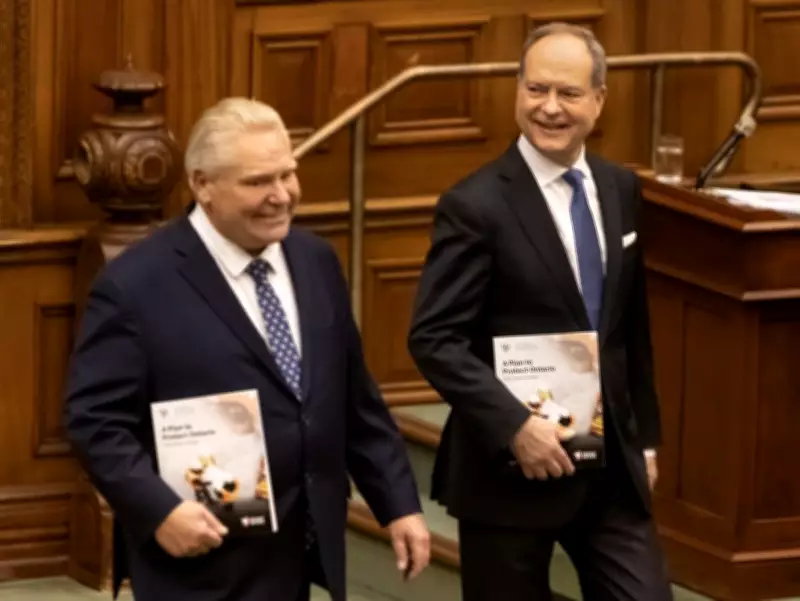
Ontario Premier Doug Ford and Finance Minister Peter Bethlenfalvy unveiled the 2026 provincial budget at Queen's Park in Toronto on March 26, 2026, marking a notable evolution in the government's fiscal strategy since taking office in 2018. While the spending figures appear cautious and moderate, the underlying philosophy has transformed from one of minimal intervention to active economic stewardship.
A Shift in Government Outlook
The budget, named A Plan to Protect Ontario, echoes the theme of its 2019 predecessor, Protecting What Matters Most, but the methods have diverged sharply. Initially focused on reducing government interference in business, the Ford administration now emphasizes support, investment, and protection for the private sector. This change aligns with broader global trends toward protectionism, largely influenced by shifts in U.S. policy under former President Donald Trump.
New $4-Billion Investment Fund
A centerpiece of the budget is the $4-billion Protect Ontario Account Investment Fund, designed to foster economic growth by partnering with private capital and pension funds. Finance Minister Bethlenfalvy described it as a tool to advance long-term strategic priorities, aiming to secure Ontario's competitiveness for the next century. The fund will be managed by a private-sector investment manager, representing a departure from the government's earlier stance against picking winners and losers in the market.

This initiative reflects a more interventionist approach, with the fund accounting for approximately 1.6% of the province's total projected spending of $244 billion for the upcoming year. The move signals a pragmatic adaptation to changing global trade dynamics and political landscapes.
Budgetary Details and Projections
Overall spending, including debt servicing, is projected to increase by 2.4%, with revenues rising by 2.3%, slightly above the inflation rate. Personal income tax revenues are expected to grow, while corporate income and sales taxes remain relatively flat. The budget deficit is estimated at $13.8 billion, though Bethlenfalvy has a history of delivering better results than initially forecast, as seen with last year's deficit coming in lower than projected.
Debt servicing costs remain a significant burden, at $17.2 billion, consuming 6.7 cents of every tax dollar collected. However, the government notes that this proportion is lower than the federal government's interest payments, offering a point of comparison.
Major Spending Increases in Key Sectors
Health spending surpasses the $100-billion mark for the first time, with a projected allocation of $101.2 billion, up from $97.8 billion last year. This represents a 63% increase since the Ford government took office, when health spending stood at $62.2 billion. Health now accounts for 41% of the total provincial budget, underscoring its priority status.
In contrast, education sees a modest rise from $40.5 billion to $40.8 billion, while post-secondary education and other programs remain largely unchanged. These figures challenge opposition claims of cuts to essential services, highlighting sustained investment in critical areas.
Conclusion: A New Fiscal Direction
The 2026 Ontario budget illustrates a government adapting to external pressures and internal priorities, moving from a hands-off approach to active economic participation. With significant funds directed toward health and business investment, the Ford administration aims to balance protectionism with growth, setting a course for Ontario's future in an uncertain global environment.