

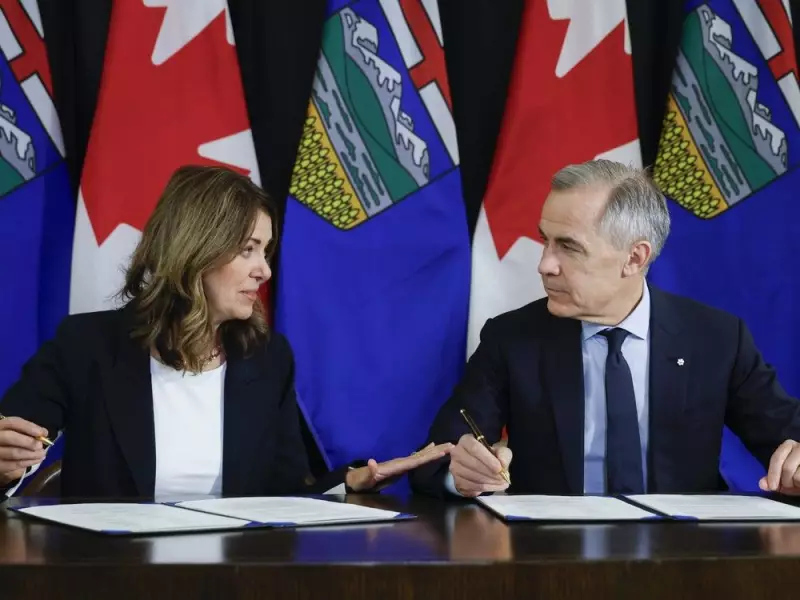
A landmark agreement between the federal government and Alberta, designed to clear the path for a new pipeline to tidewater, is being met with resistance from British Columbia, creating a significant interprovincial rift. Analysts warn this political stalemate threatens to stifle the investment and economic growth that both Western provinces urgently need.
The Deal and the Dispute
On November 27, 2025, Prime Minister Mark Carney and Alberta Premier Danielle Smith formalized a pact in Calgary aimed at overcoming long-standing barriers to energy infrastructure. The agreement proposes key adjustments: modifying the federal tanker ban on B.C.'s north coast, removing Alberta's emissions cap in exchange for a higher industrial carbon tax, and committing to Indigenous co-ownership of any resulting pipeline.
However, the government of British Columbia, led by Premier David Eby, has dismissed Alberta's proposal as "fictional" and a "communications exercise." This stance directly contradicts B.C.'s own Look West economic strategy, which promotes the province as "Canada's gateway to the Pacific." Critics argue that by seeking to control what resources can be exported, B.C. is acting as a gatekeeper rather than a gateway.

Economic Stakes and Hypocrisy Concerns
The financial pressures on both provinces make the dispute particularly consequential. British Columbia is grappling with a record $11.6-billion deficit and its longest public service strike in history. Alberta is also under significant financial strain. Neither province can afford to turn away new investment that would create revenue and opportunity on both sides of the Rockies.
The authors of the original opinion piece, Keyli Loeppky and Ryan Mitton, highlight a perceived hypocrisy. They note that while Canada's premiers recently established a Canadian Mutual Recognition Agreement to reduce internal trade barriers, B.C. is "digging in its heels on the very infrastructure that enables trade." They point out that Premier Eby celebrates free trade for B.C. wine but opposes it for Alberta energy, arguing that Alberta's energy and B.C.'s ports are two ends of the same economic corridor.
Broader Consequences for Investor Confidence
Beyond the immediate project, Eby's framing that one pipeline could "threaten" other developments is seen as dangerous. This zero-sum approach, analysts warn, pits industries against each other and undermines broader investor confidence in British Columbia. The message sent is that the province may be hostile to new ideas, not just those from the resource sector.
The economic argument for the project is underscored by productivity data. According to recent figures from the Business Council of B.C., labour productivity in the oil and gas sector is more than four times higher than in any other industry. Blocking growth in one of Canada's most efficient economic engines, the argument goes, is a missed opportunity for generating the government revenues needed to address deficits and fund public services.
Ultimately, the dispute underscores a critical challenge for Western Canada: transforming the vision of interconnected prosperity into reality requires more than strategies and agreements—it demands political cooperation to build the infrastructure that unlocks productivity and trade for all.






