

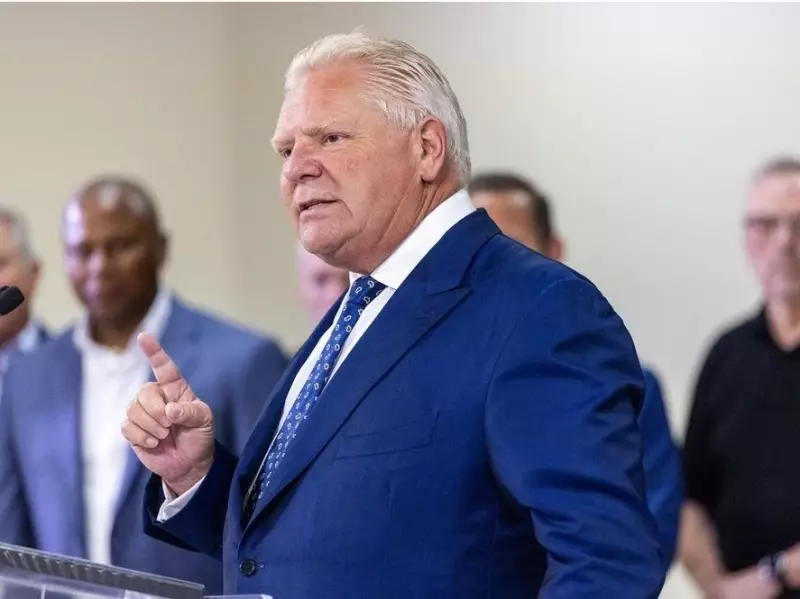
Ontario Premier Doug Ford has frequently positioned himself as a prudent fiscal manager, a stark contrast to what he labelled the "reckless" spending of his Liberal predecessor, Kathleen Wynne. However, a detailed examination of provincial financial data reveals a striking continuity in the government's spend-and-borrow approach, raising questions about the substance behind the political rhetoric.
Spending Levels: A Comparative Analysis
When adjusted for inflation, program spending per person under Premier Ford is projected to reach $14,222 for the current fiscal year. This figure notably exceeds the peak per-person spending during Wynne's tenure, which was $13,873 in her final year, 2017-18. This metric includes all government expenditures except for debt interest payments.
Another critical measure is spending relative to the size of Ontario's economy, or Gross Domestic Product (GDP). Under the Wynne government, this ratio fluctuated between 16.6% and 17.7%. The Ford government's own projections indicate its spending will reach 17.8% of provincial GDP this year, slightly above the highest point recorded under the Liberals.

Deficits and Debt: A Persistent Pattern
This sustained level of expenditure has resulted in consistent budget shortfalls. Aside from the 2021-22 fiscal year, where high inflation temporarily boosted government revenues, the Ford government has run a deficit every year since taking office in 2018. The projected deficit for this year stands at $14.6 billion in nominal terms, which is larger than any single deficit run under the previous Liberal administration.
Deficits, by their nature, lead to increased debt. The Ford government initially declared reducing Ontario's debt burden a "moral imperative" in 2018. Yet, progress has been limited. The province's debt-to-GDP ratio—a key indicator of fiscal sustainability—is projected to be 37.9% this year. According to the government's latest budget, the total provincial debt is on track to hit $500 billion by the 2027-28 fiscal year, with the debt-to-GDP ratio rising to 38.6%.
The Political and Fiscal Implications
The data presents a clear challenge to the narrative of a sharp fiscal divide between the two administrations. If the spending levels of the Wynne era were deemed reckless by Ford and his supporters, the current government's similar, and in some measures higher, spending trajectory invites the same critique. The analysis underscores a broader political reality: while governments may change, the pressures to fund public services and respond to economic challenges often lead to similar fiscal outcomes.
The trajectory of Ontario's finances under Ford suggests that, despite the premier's self-described "prudent" and "staunch fiscal conservative" branding, the province's fiscal path remains closely aligned with the spend-and-borrow approach he once vehemently opposed. The long-term consequences of this path, including the growing debt load, will be a defining issue for Ontario's economic future.






