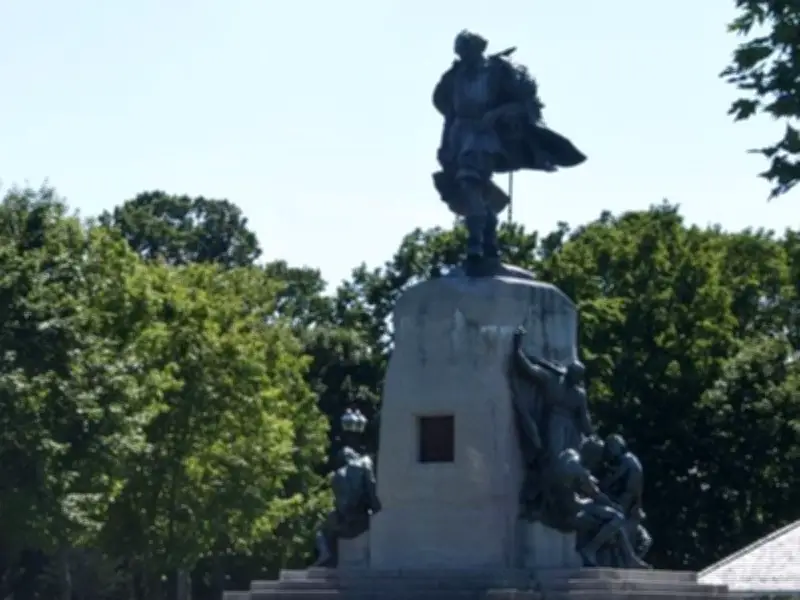
The forces of historical ignorance and vandalism have once again struck in Ontario. This time, the freshly spray-painted statue of Samuel de Champlain, inaugurated in Orillia in 1925 to honour the 300th anniversary of his visit to the area in 1615, has been removed, even though most people apparently want it kept in place.
Champlain was once an integral part of Ontario's history. He was an expert navigator, a brave commander, a courageous explorer, an extraordinary cartographer, and a writer and deeply observant anthropologist who left the world with the best and most complete descriptions of the Indigenous peoples of the Ottawa Valley and Georgian Bay. Students learned about him in history classes.
A Legacy of Friendship with Indigenous Peoples
The renowned American historian David Hackett Fischer concluded his massive biography, Champlain's Dream, by hailing Champlain as the founder of a generous and humane colony, one of the great humanists of his day. That extraordinary generation included William Shakespeare, Caravaggio, Johannes Kepler and Galileo, to name but a few. But Champlain has largely been removed from Ontario's curriculum.

He was an honoured friend of the Wendat people. When asked by them to help in their war with the Haudenosaunee (known as Iroquois by the French) of upstate New York, he responded to the call and travelled from Quebec City to the Penetang peninsula on Georgian Bay in 1615. Together, the clutch of French soldiers and Wendat warriors crossed Lake Ontario and attacked the enemy. When Champlain was injured in that battle, the Wendat warriors carried him on their backs and insisted that he winter with them in their villages.
When the Haudenosaunee carried out their most murderous campaign against the Wendat in the 1640s and 1650s, the survivors moved north and found refuge near Quebec, the settlement founded by Champlain in 1608. In other words, it was a fruitful relationship, the very kind of partnership between French pioneers and Indigenous peoples that should be celebrated and remembered. Yet that's not good enough for 21st-century Ontario.
Historical Significance of the Orillia Monument
It was good enough 100 years ago. The monument created by Vernon March (who also designed the spectacular cenotaph in Ottawa) that was unveiled in Orillia to honour and remember Champlain's visit 300 years earlier went beyond honouring the French explorer. It recognized the Indigenous population, the coureurs de bois and the missionaries. There was obviously a hierarchy — after all, Champlain was the effective governor of New France.
It also represented a moment of national unity between the English and the French in the 1920s. A new spirit of rapprochement after the First World War was shaping the national culture, and within a couple of years of this monument's construction, Ontario stopped enforcing a regulation that denied francophones the right to an education in their own language. Indigenous leaders were present when the monument was unveiled before a crowd of 10,000 people, and for nearly 100 years it served as a historical marker.