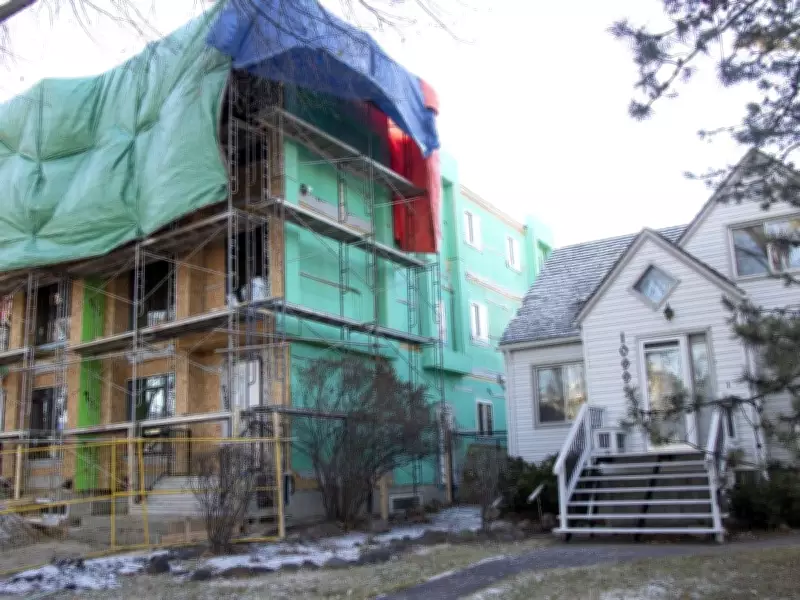
Edmonton city council is currently engaged in discussions regarding a proposed bylaw that would significantly alter the maximum height regulations for new infill buildings throughout the city. As a public hearing extends into its sixth hour, council members are poised to deliberate on zoning changes that could reshape Edmonton's urban landscape.
Proposed Height Reduction for Infill Developments
Under the newly proposed regulations, the maximum wall height for RS Zone developments—the most common type of infill construction—would be reduced to 9.5 metres from the previous allowance of 10.5 metres. Buildings featuring pointed roofs may still reach peak heights of 10.5 metres, but must taper down to comply with the new wall height limitations.
"Last summer we reduced the length that buildings can be and I'm supportive of also reducing the height as well," stated Ward O-day'min Councillor Anne Stevenson, who chaired the hearing. "We were seeing numerous rezonings coming forward with minimal increases to what's permitted. This created substantial uncertainty within communities and increased workload during our public hearings."

Strategic Policy Adjustments
Councillor Stevenson emphasized that city building represents an ongoing, iterative process requiring continuous adaptation. "We always want to be improving our policies and bylaws to ensure they reflect community feedback and align with our collective goals as a city," she explained.
The proposed bylaw emerged as a compromise solution following extensive community consultations regarding concerns about the "massing" of new developments while still permitting three-storey constructions. The legislation also introduces new provisions for existing properties, allowing owners to request variances for building additions, enlargements, or exterior alterations that wouldn't need to adhere to the 9.5-metre wall height limit, though they would remain constrained by the maximum height specified in the original development permit.
Council Proceedings and International Context
Mayor Andrew Knack participated remotely from Tianjin, China, navigating a challenging 14-hour time difference that required him to begin the 9:30 a.m. meeting at 11:30 p.m. local time. Council deliberations on the bylaw were expected to extend past 6 a.m. in his location.
Ward papastew Councillor Michael Janz noted that discussions about managing infill development productively are occurring in major cities worldwide. "The conversation about how Edmonton can gracefully grow to accommodate two million residents and beyond remains ongoing," Janz remarked. "Infill represents a dynamic, evolving process rather than a completed endeavor."
Global Perspectives on Urban Development
Councillor Janz highlighted that even historic European cities are confronting similar challenges. "Cities like Paris and London are currently exploring methods to integrate additional housing into core urban areas while respecting centuries-old architectural heritage," he observed. "This represents a continuous, evolving dialogue about urban development."
If approved, the new regulations would take effect on August 1. Council was also scheduled to review proposed amendments to district bylaws that would permit four-storey buildings within 400 metres of mass transit stations and along arterial roads, or on corner lots adjacent to arterial roads. However, this discussion was postponed until the April 27 public hearing due to the substantial number of speakers addressing other agenda items.
The proposed height reduction represents Edmonton's latest effort to balance community concerns with development needs as the city continues its growth trajectory toward becoming a major metropolitan center.