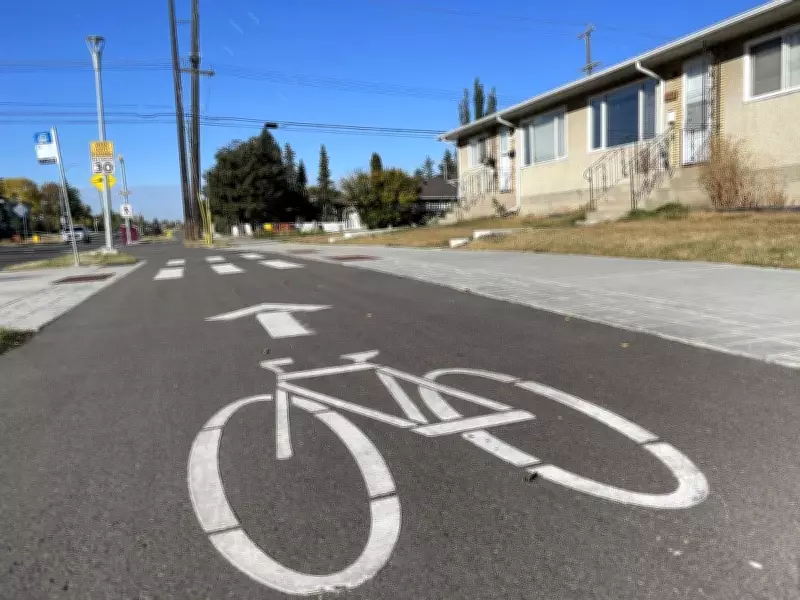
City Administration Acknowledges Oversight in 132 Avenue Roadway Redesign
During a Wednesday infrastructure committee meeting, Edmonton city officials publicly admitted they had "missed" planning for windrow removal in their redesign of 132 Avenue, which involves reducing the major roadway from four lanes to two. The admission came as Councillor Erin Rutherford questioned the effectiveness of the city's neighborhood renewal program at street level.
Councillor Rutherford Highlights Practical Roadway Issues
Ward Anirniq Councillor Erin Rutherford shared her firsthand experience navigating 132 Avenue, describing how windrows completely blocked on-street parking areas. "Today, I was driving on 132 Avenue to work," Rutherford stated. "There was a windrow that was completely blocking the on-street parking. There was no way you could even park a car there."
She noted particular concern for accessibility, explaining that even designated handicap parking spots were partially obstructed. "That's the kind of stuff that really frustrates Edmontonians and gives neighborhood renewal a bad name," Rutherford emphasized. "If we're going to rebuild these roads and redesign them completely, there needs to be a subsequent reallocation of service standards."

City Official Admits Planning Failure
Parks and Road Services branch manager Caitlin Zerebeski acknowledged the oversight in the renewal plan. "With 132 Avenue, I can say that is a miss," Zerebeski confessed. "That should have been a recommendation. With the shrinking of the road, without those two lanes going east and west, the only place to put the windrows or the snow was on that curb lane."
Zerebeski explained that the roadway previously wasn't designated as a windrow-free zone, but recognized the new design created different challenges. "Your point is noted that with the shrinking of the roadway with less places to put that snow, there needs to be a re-look at where that snow can go and if it can't go anywhere then it needs to be picked up."
Committee Directs Financial Analysis of Renewal Program
The infrastructure committee voted unanimously to direct administration to prepare a memo examining the financial implications of maintaining the current neighborhood renewal model versus tying funding to inflation and the city's asset inventory. This analysis must be completed before deliberations on the next four-year budget cycle begin.
A previous committee had requested a 2024 review of the neighborhood renewal program to identify potential policy changes before the upcoming budget cycle. However, administration had recommended keeping existing policies unchanged.
Seasonal Transition from Snow Removal to Street Sweeping
The windrow discussion may become temporarily academic as Edmonton transitions from winter operations to spring cleaning. With Environment Canada forecasting warmer weather, city officials have shifted focus from snow removal to street sweeping, which began April 7 and will continue through June 1.
Major roadways will be swept overnight to minimize traffic disruption, while staggered residential parking bans will be implemented from April 13, operating from 7 a.m. to 7 p.m. Residents should note that vehicles left parked on the street during these bans could receive a $250 fine.
The committee's directive represents a significant step toward potentially reforming how Edmonton approaches neighborhood renewal projects, ensuring future redesigns consider all operational impacts from the planning stage forward.