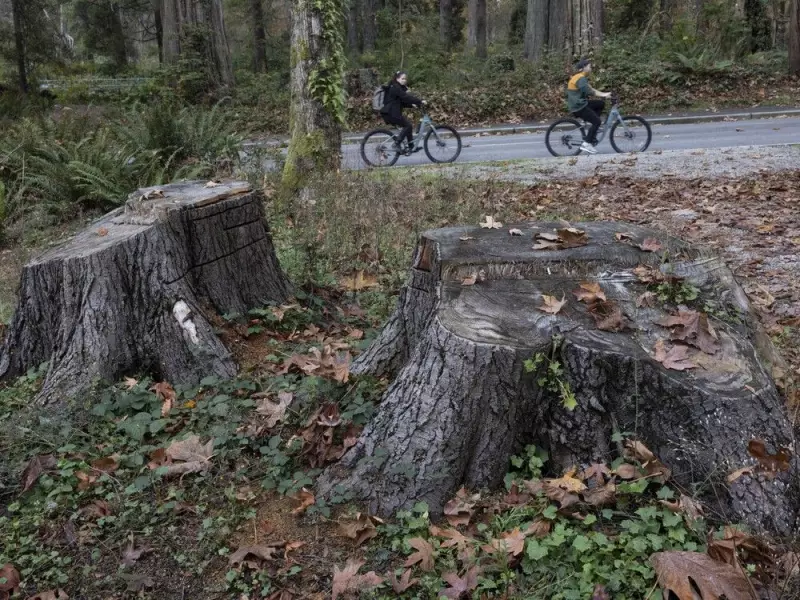
The British Columbia Supreme Court has delivered a decisive ruling, allowing the City of Vancouver to proceed with the controversial removal of thousands of trees in the iconic Stanley Park. The decision, handed down by Justice Jasvinder Basran, rejects a legal challenge from a preservation group and affirms the legitimacy of the city's current contracts to address a severe hemlock looper moth infestation.
Legal Challenge Dismissed, Work to Continue
The Stanley Park Preservation Society had filed a petition earlier this year seeking a judicial review and an injunction to halt the logging, arguing it should be limited only to trees posing an immediate public danger. The society's spokesperson, Michael Robert Caditz, indicated on Friday that the group is considering an urgent appeal to stop the removal. However, Justice Basran's ruling clears the path for the city's planned third and final phase of the mitigation work.
In his analysis, Justice Basran reviewed transcripts from park board meetings and concluded that commissioners had carefully considered the society's concerns before approving the later phases of the project. The park board, in an emailed statement, expressed pleasure with the court's decision, confirming that forest mitigation and restoration work can continue into its third phase beginning later in January 2026.

A Technical Win and a Broader Loss
While the overall ruling favoured the city, the preservation society secured a technical victory on one specific point. Justice Basran found that the initial 2023 tree removal contract, a $1.9 million sole-source agreement with B.A. Blackwell and Associates to log approximately 7,000 trees, was improper. He ruled that the city lacked the authority to enter a contract affecting a park worth over $750,000 without obtaining explicit approval from the elected park board commissioners, which it had not done.
This finding highlights the ongoing political tension surrounding the park board, an institution Mayor Ken Sim's ABC Party is seeking to eliminate. Despite this flaw in the initial contract, the justice upheld the subsequent phases. He ruled that the second and third phases of the tree removal were properly approved by the park board and that the board's resolutions to proceed were fair.
The Root of the Controversy: Safety and Infestation
The entire tree removal program was initiated as a direct response to a devastating outbreak of the hemlock looper moth. The city has consistently argued that the infestation caused significant damage to hemlock trees, creating a substantial fire hazard and public safety risk from dead and weakened trees falling. Advanced work on the final Phase 3, which will focus on 20 percent of the forested area and the removal of 2,486 trees, was already underway from early- to mid-2025.
With this legal hurdle now cleared, the City of Vancouver and the park board are authorized to complete their forest health management plan. The ruling emphasizes the city's obligation to manage public safety in its parks, even when such actions involve difficult decisions about altering a beloved natural landscape.