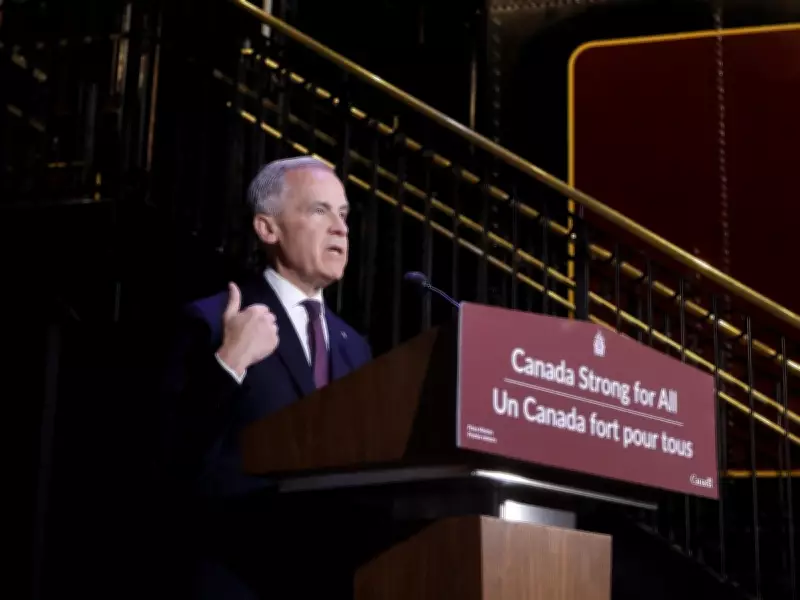
Prime Minister Mark Carney speaks during an investment announcement at the Canadian Science and Technology Museum in Ottawa on Monday. Photo by Blair Gable / Postmedia
A Wealth Fund Without Surplus Wealth
Sovereign wealth funds are typically established by countries to manage their surplus wealth. However, Canada has just established the Canada Strong Fund — this country’s first national sovereign wealth fund — despite being deeply in the red. In short, there is no surplus wealth to manage.
Mark Carney said there will be good news in the spring fiscal update the government will deliver on Tuesday. Are we to take it then, that the $65.4-billion deficit projected in the fall budget for the current fiscal year has evaporated and the new fund the prime minister announced on Monday will be financed from this windfall?

Probably not. Carney was asked how the government can afford another $25 billion in seed funding when big deficits remain. He said the government is spending less, so it can invest more and Canadians will now have the chance, through their government and as individuals, to partake in investing in major projects.
The People's Fund
The new fund — “the people’s fund” — will act as a “national savings and investment account,” he said. The mechanics and the mandate remain vague, but the fund will operate at arm’s-length from government as a Crown corporation, investing alongside the private sector in “nation-building projects.” “The people of Canada deserve a share,” alongside the private sector, Carney said.
Comparison with Existing Institutions
The prime minister was asked how the new fund will differ from existing efforts to catalyze private-sector investment, such as the Canada Infrastructure Bank (CIB) and the Canada Growth Fund. The CIB, in particular, has proven to be such a disappointment since it was established in 2017 that in 2022 the House of Commons transport committee recommended it be abolished. It has been the constant recipient of criticism over lack of transparency, inefficiency and high costs.
Carney distinguished between the role of the CIB and the new fund. He said the CIB provides debt, whereas the new fund will take equity stakes. “(With debt), you don’t get the returns from the underlying business (as you do) when the equity returns to the owners, which are substantial, if it’s well run,” he said.
Risks and Priorities
That caveat should raise concerns for taxpayers. What is the priority here? Is it wealth preservation, investment returns or strategic development support? If it is to build wealth for Canadians, as befits a “national savings and investment account” — the money should probably be invested in global stocks. The MSCI All Country World Index — a common benchmark for global equities — delivered a total return of over 21 per cent last year. But if, as seems more likely, it is to fast-track major projects, it probably shouldn’t be presented as a safe-as-houses investment opportunity.
The returns are clearly not as guaranteed as the prime minister made them sound. The Alberta Heritage Savings Trust, that province’s sovereign wealth fund, lost billions during the Great Recession and during COVID. It has proven to be a major disappointment in terms of its growth.