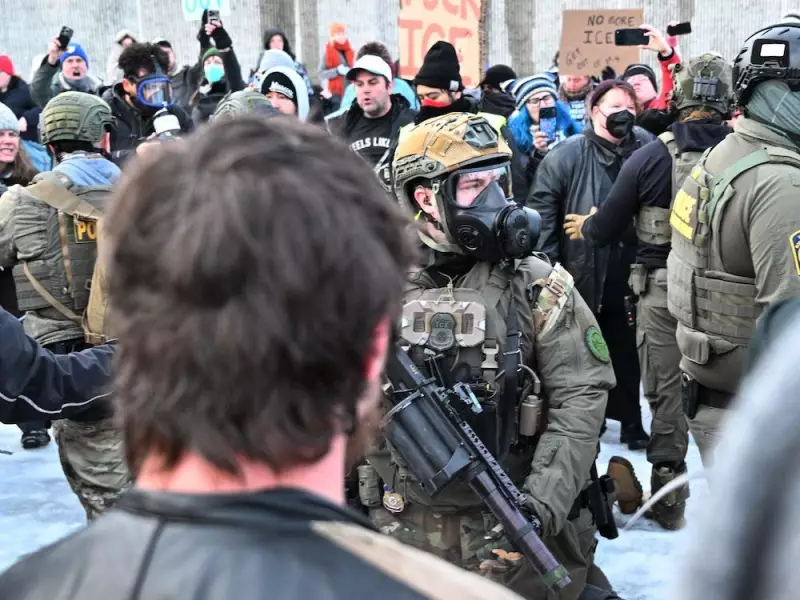
The fatal shooting of Renee Nicole Good by Immigration and Customs Enforcement (ICE) agents in Minneapolis on January 7, 2026, was a tragic event that many saw coming. In today's highly charged political and law enforcement environment, such a violent clash was, sadly, almost inevitable.
A System Primed for Conflict
For decades, politicians and the judicial system have steadily elevated police and federal agents into a privileged class, often shielded from accountability and expecting immediate public deference. This culture of impunity has developed alongside a nation fracturing along deep ideological and partisan lines, where political factions grow increasingly confrontational and willing to engage in violence.
These two dangerous trends collided in Minneapolis. On one side were ICE agents, a force wielded as a political weapon by the Trump administration. On the other were opposition activists with a history of clashing with federal authorities. The result was the death of Renee Nicole Good.

The Political Powder Keg in Minnesota
Zooming out from the immediate incident reveals a landscape deliberately primed for conflict. Shortly before the shooting, the Trump administration announced it was deploying up to 2,000 federal agents to Minnesota. ICE Acting Director Todd Lyons called it the “largest immigration operation ever.”
This massive deployment was not occurring in a vacuum. It came as federal officials sparred with Minnesota Democrats, notably Governor Tim Walz, over revelations of significant social program fraud in the state involving Somali immigrants. For border-focused officials, this presented a clear opportunity to politically embarrass their opponents.
The political motivation was overt. In June, President Trump posted on Truth Social, targeting Democrat-led cities like Los Angeles, Chicago, and New York—and by extension, Minneapolis—as places where illegal immigrants are used to “expand their Voter Base, cheat in Elections, and grow the Welfare State.” The stage was set for a partisan showdown.
Escalating Tensions and Violent Confrontations
Even before the Minneapolis operation was announced, federal agents faced volatile resistance in other major cities. In the nation's capital, protests quickly turned violent. In Los Angeles, demonstrations against federal actions saw protesters lobbing bottles, fireworks, and chunks of concrete at police officers, as reported by the Los Angeles Times.
This context of escalating hostility frames the Minneapolis tragedy. While much of the public response has involved meticulous, JFK-assassination-style analysis of the shooting video and DHS use-of-force guidelines—an important exercise—it misses the larger, more disturbing picture.
The fundamental concern is that when a hyper-politicized federal force is sent into the heart of a political battleground, violence becomes a predictable outcome, not a shocking anomaly. The question of whether the shooting was legally justified, while crucial for accountability, is secondary to the systemic failures that made such a deadly encounter likely from the start.