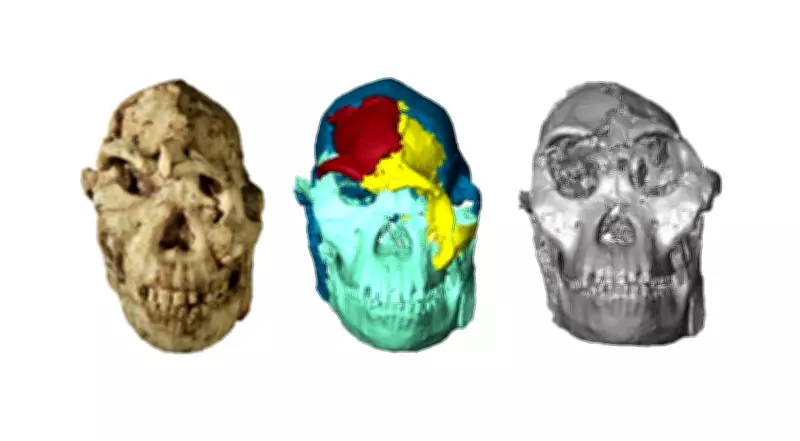
Digital Reconstruction Reveals the Face of 'Little Foot,' a Nearly 4-Million-Year-Old Human Ancestor
In a groundbreaking scientific achievement, researchers have unveiled a digital reconstruction of the face of 'Little Foot,' a remarkably preserved fossil of a human ancestor dating back nearly 4 million years. This discovery, based on advanced scanning techniques, provides an unprecedented glimpse into the appearance of one of our earliest known relatives, shedding new light on human evolution.
Unveiling an Ancient Visage
The reconstruction was created by scanning the skull of Little Foot, an Australopithecus specimen discovered in the Sterkfontein Caves of South Africa. Using high-resolution imaging and digital modeling, scientists from Wits University, in collaboration with international teams, have pieced together a more complete and accurate representation of this individual's facial features. The process involved meticulous analysis of bone fragments and anatomical markers, allowing for a detailed recreation that highlights key characteristics such as a prominent brow ridge, a flatter nasal area, and a robust jawline typical of early hominins.
Significance for Human Evolution
This digital reconstruction is not merely an artistic endeavor; it holds profound implications for understanding human ancestry. Little Foot, belonging to the species Australopithecus prometheus, offers clues about the transition from ape-like ancestors to more human-like forms. By examining the facial structure, researchers can infer aspects of diet, social behavior, and environmental adaptations. For instance, the reconstructed features suggest a diet that included tough plant materials, aligning with other Australopithecus fossils found in similar regions.

The findings challenge previous assumptions about the diversity and morphology of early human ancestors. Little Foot's skull, which shows a mix of primitive and advanced traits, underscores the complexity of evolutionary pathways. This reconstruction allows paleoanthropologists to compare Little Foot with other hominin species, such as Lucy (Australopithecus afarensis), to better map out the family tree of humanity.
Technological Innovations in Paleontology
The project showcases the growing role of technology in paleontological research. By employing non-invasive scanning methods, scientists can study fragile fossils without risking damage, preserving them for future generations. The digital models also enable virtual dissections and simulations, offering insights into brain size, muscle attachments, and sensory capabilities. This approach has revolutionized the field, allowing for more precise and collaborative studies across global research institutions.
As Dr. Amelie Beaudet, a lead researcher on the project, noted, "This reconstruction brings Little Foot to life in a way that was impossible just a few decades ago. It helps us visualize our ancient past and understand the physical changes that shaped human evolution."
Future Research Directions
The revelation of Little Foot's face opens new avenues for exploration. Researchers plan to use the digital model to conduct further analyses, such as biomechanical studies of chewing patterns and investigations into vocal tract anatomy. Additionally, this work may inspire similar reconstructions of other fossil specimens, contributing to a more comprehensive picture of human origins. The ongoing study of Little Foot continues to yield valuable data, with potential implications for fields ranging from anthropology to genetics.
In summary, the digital reconstruction of Little Foot's face marks a significant milestone in paleoanthropology. By combining cutting-edge technology with meticulous scientific inquiry, it enriches our understanding of a nearly 4-million-year-old human ancestor and highlights the intricate journey of human evolution.