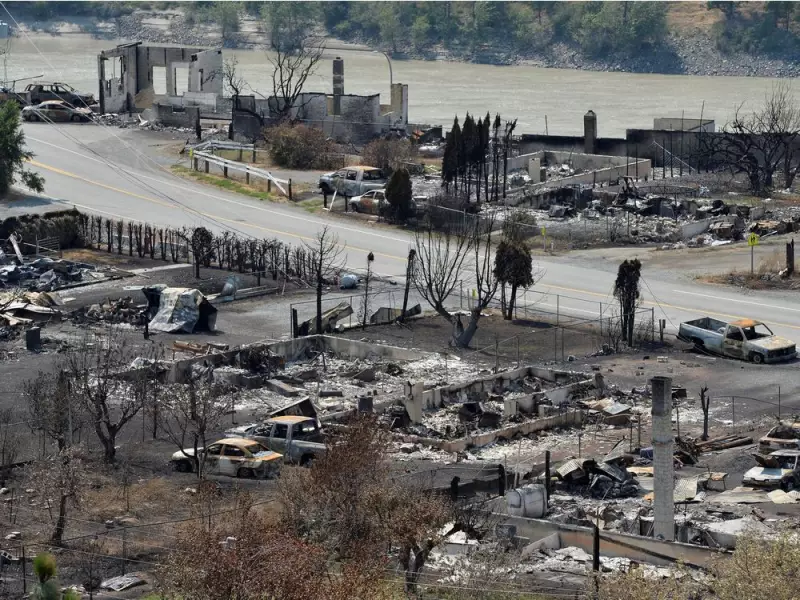
A British Columbia Supreme Court judge has ruled there is sufficient evidence to allow a major class-action lawsuit to proceed against Canada's two largest railway companies over their alleged role in the catastrophic wildfire that destroyed the village of Lytton in June 2021.
The Court's Groundbreaking Decision
In a decision released on Tuesday, Justice Ward Branch certified the class action, finding there is 'some basis in fact' to support the plaintiffs' claims that operations by Canadian Pacific (CP) and Canadian National (CN) railways could have caused the deadly blaze. The lawsuit targets the rival companies, whose parallel tracks run through the community located roughly 100 kilometres north of Hope.
Justice Branch's written reasons detail the unique operational agreement between the two rail giants. 'CN and CP have, by agreement, granted one another the right to operate trains on each other’s tracks,' he noted. The judge explained that under this pact, westbound trains predominantly use the CN track, which is the specific line implicated by the plaintiffs' hypothesis for the fire's origin.

Seeking Justice for a Community in Ruins
The representative plaintiffs leading the action are Carel Moiseiwitsch, who lost his Lytton home and business, and Jordan Spinks, a member of the Kanaka Bar Indian Band who was displaced by the disaster. The lawsuit is open to anyone who suffered losses in the fire, which burned nearly the entire town to the ground.
Nearly four years later, Lytton's recovery has been painfully slow, with very few new buildings standing. This legal action represents a renewed effort for accountability after a previous attempt at a class action was dismissed in 2023.
Contradicting Official Findings and Extreme Conditions
The court's decision stands in contrast to a 2021 finding by the Transportation Safety Board (TSB), which ruled it found no link between rail activity and the Lytton fire. Critics, including Vancouver lawyer Jason Gratl, have previously argued the TSB investigation lacked sufficient resources and depth.
The fire erupted during an unprecedented heat dome that shattered temperature records across B.C. Lytton itself recorded a staggering 49.6 degrees Celsius on June 29, 2021, just one day before the inferno began. The extreme conditions are a critical backdrop to the legal arguments about what may have sparked the tinder-dry landscape.
With the class action now certified, the case moves forward, potentially setting a significant precedent for holding major industrial operators accountable for disasters in an era of increasing climate volatility.