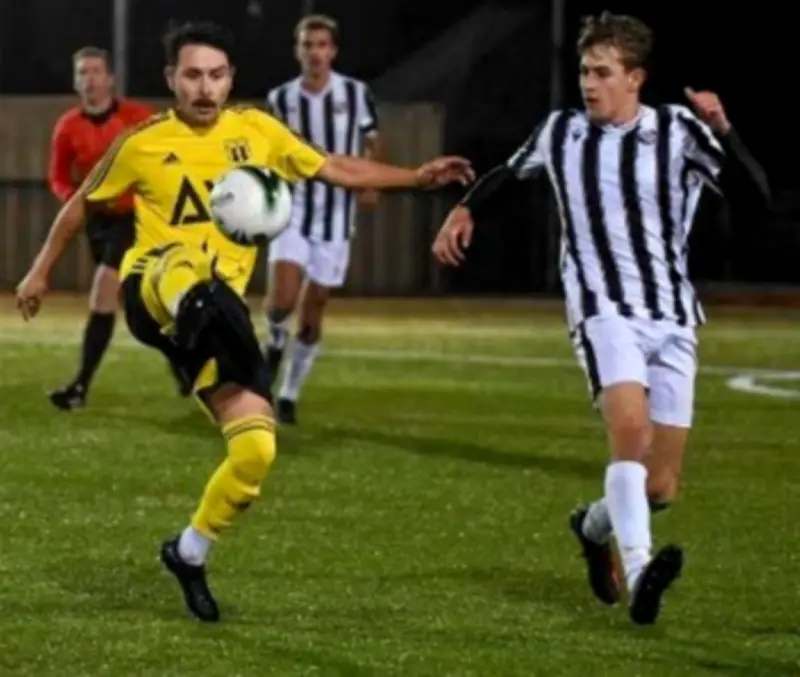
Soccer culture in the First Nations communities of Vancouver Island dates back over a hundred years, introduced by early settlers and Catholic and Anglican priests who operated residential schools. For many Indigenous children who suffered while attending these schools, soccer became an outlet and remains a passionate community-driven sport today.
Modern Day Warfare on the Pitch
“We have Indigenous soccer tournaments that go up and down the coast,” says Mateo Kostering, an Indigenous soccer player and founder of Indigenous Athletics Academy (iaasoccer.com), a non-profit organization focused on creating meaningful opportunities for Indigenous youth through sport. “What started out as an outlet for residential school students has become modern day warfare. Every village runs fundraisers to support soccer, and the best players become local legends.”
Kostering is a proud member of the Musgamagw Dzawada’enuxw First Nation, but he grew up playing soccer on the ’Namgis First Nation on Northern Vancouver Island. He credits his involvement in the sport with motivating him to finish high school and complete a university degree majoring in First Nations Studies and Physical Education. Kostering briefly dropped out of high school, but soccer brought him back, and the desire to play for the Vancouver Island University (VIU) Mariners motivated him to attend university.

Life Lessons Beyond the Field
“While I was playing soccer, I worked on my degree,” he says. “I also met my wife at university and we started a family.” Playing soccer helps youth become physically fit and mentally sharp, teaching lessons that extend far beyond the field such as teamwork, resilience, sportsmanship, and discipline. “Soccer saved my life,” Kostering says. “It brought me to places around Canada and North America, and it helped me complete my education.”
In 2024, Mateo and Jessica Kostering founded Indigenous Athletics Academy with the goal of helping Indigenous youth grow as athletes and build life skills. With the help of Darian and Sarah Harris working as coaches, more than 700 youth participated in the organization’s soccer camps in 2024 and 2025, improving their soccer skills, building confidence, and benefiting from community mentorship.
Bridging Two Worlds
“In addition to helping them become better athletes, we want to expose youth to the possibilities soccer can bring into their lives,” says Kostering. “It’s possible to live in both worlds — to be Indigenous and to play the game at an elite level.” Indigenous athletes are under-represented in professional sports in North America. While Canada’s senior men’s national team is very diverse, there are no Indigenous players on the team and none on the 2026 World Cup roster. “The issue isn’t talent,” Kostering says. “We have many talented Indigenous soccer players in Canada. Our people struggle to leave the reserve and play at higher levels. Players who have a lot of support in their community can feel lonely when they’re playing on elite teams.”