Thousands marched in Kyiv Pride last Sunday, defying the threat of Russian bombings and nationalist counterprotesters, in a powerful display of Ukraine's Europeanization. The message was clear: while Ukrainian society increasingly accepts LGBT people, the government is failing to keep pace and deliver overdue reforms.
History of Kyiv Pride
Pride marches are not new to Kyiv. The first attempt was in 2012, after then-president Viktor Yanukovych proposed a Kremlin-inspired “gay propaganda” law that would have criminalized public LGBT activism. That march was aborted when thousands of counterprotesters arrived with bats and other weapons. However, foreign diplomats and journalists joined in subsequent years, forcing local police to provide proper security.
Attendance steadily grew over time, especially after the 2014 pro-western Euromaidan Revolution. By 2021, 7,000 marchers were met by only a few hundred counterprotesters. Kyiv Pride was paused after Russia’s full-scale invasion in 2022 but resumed last year at a smaller wartime scale of 1,500 participants.

Security Concerns and Counterprotesters
Security was a significant concern before this year's march. Counterprotesters were anticipated, but the risk of military conscription was believed to deter hooliganism. However, Ukraine had bombed Moscow’s main oil refineries a few days earlier, and retaliation was expected. Could a Russian drone or missile turn Pride into a mass casualty event?
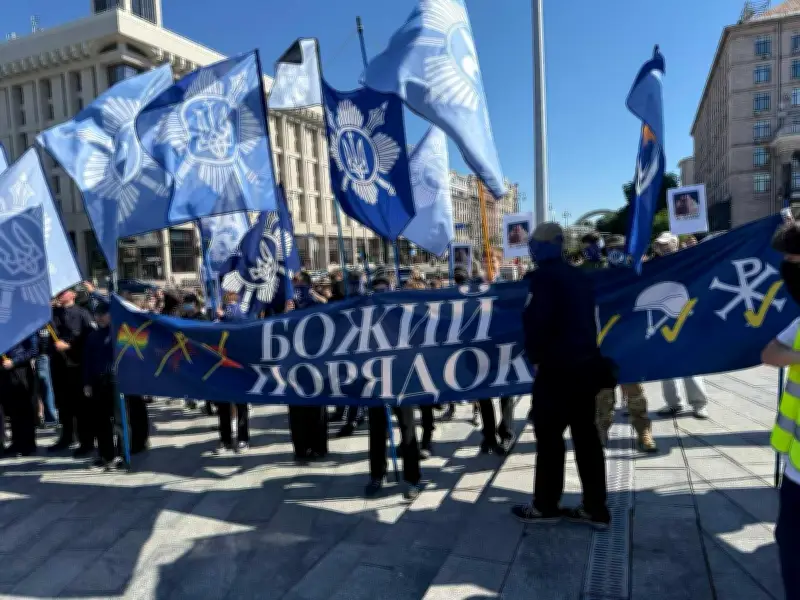
On the morning of the march, I passed by Maidan Square, the heart of the capital, and stumbled upon ultra-nationalist counterprotesters assembled beside the forest of flags memorializing Ukraine’s wartime dead. There were around 700 to 900 young men, predominantly below conscription age, dressed in black with faces covered by scarves, hoods, and sunglasses. They were organized into a long, battalion-like formation, five rows deep, terminating in a group carrying sky-blue flags and a banner labeled “God’s Order” that compared gay rights to Satanism.
The young men roared slogans and thumped their chests in unison. One, wearing a cross and armband, brandished a crucifix like a theatre prop.
Organizer's Perspective
“This is a march for marriage, family and Ukraine… It is not only about morality, it is about national security,” explained Ruslan Kukharchuk, one of the event’s organizers, as we stood on the steps above the crowd. He emphasized that Ukraine’s population had decreased by 20 million people over the past three decades and that opposing gay pride is essential to fighting demographic decline.
I asked him why LGBT people should be considered a major cause of Ukraine’s depopulation — as opposed to emigration, low-fertility rates, and Russia’s invasion — and what he thought about gay soldiers fighting on the frontlines. Kukharchuk responded that gays promote a “child-free ideology” and that same-sex couples cannot give birth. As for gay soldiers, he dismissed their existence as “fake propaganda,” claiming there are only two or three who primarily focus on “making LGBT propaganda” in the media. He argued that even if gay soldiers exist, it “means nothing” as alcoholics and drug addicts can be soldiers too.
Impact and Demands
The march proceeded despite the risks, with attendees including LGBT soldiers demanding equality. The event highlighted the gap between societal acceptance and government inaction on reforms such as legalizing same-sex marriage and partnership rights. As Ukraine continues to fight for its survival against Russian aggression, the struggle for LGBT rights remains a crucial test of its commitment to European values.