In a defiant display of continuity, Venezuela's ruling party lawmakers convened in Caracas on Monday, January 5, 2026, to swear in a new government term. This move was a direct response to the stunning capture of the country's long-time authoritarian leader, Nicolas Maduro, by United States forces just days earlier.
A Ceremony of Defiance and Continuity
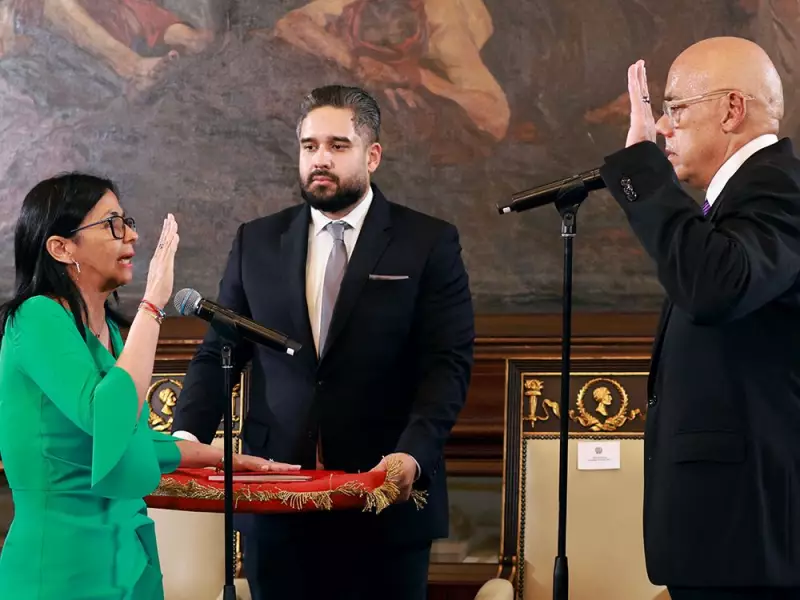
The session in the National Assembly proceeded as scheduled, inaugurating lawmakers for a legislative term set to extend until 2031. The central act was the swearing-in of Delcy Rodriguez as Venezuela's interim president. Rodriguez, who served as vice-president under Maduro, took the oath with her right hand raised, administered by her brother, Jorge Rodriguez, who was re-elected as the assembly's speaker.
"I come with sorrow for the suffering inflicted upon the Venezuelan people following an illegitimate military aggression against our homeland," Rodriguez stated during the ceremony, framing the U.S. operation as an act of aggression.

Maduro's Son Issues Stark Global Warning
The proceedings were heavily focused on condemning the arrest of Nicolas Maduro, who was seized along with his wife, Cilia Flores, from their home on a military base on Saturday. The most poignant condemnation came from Maduro's son, Nicolas Maduro Guerra, also known as "Nicolasito," in his first public remarks since the incident.
"If we normalize the kidnapping of a head of state, no country is safe," Maduro Guerra warned lawmakers. "Today, it's Venezuela. Tomorrow, it could be any nation that refuses to submit." He characterized the arrest not merely as a regional issue but as a direct threat to global political stability.
Maduro Guerra demanded the immediate return of his father and stepmother to Venezuela and denounced his own designation as a co-conspirator in the U.S. federal indictment. The indictment charges Maduro and Flores with narco-terrorism, which the Trump administration cited as justification for the extraordinary capture operation.
Parallel Proceedings: Courtroom in New York
As Venezuelan lawmakers met in Caracas, Nicolas Maduro appeared for the first time in a U.S. courtroom. He pleaded not guilty to federal drug-trafficking charges, declaring himself an "innocent" and "decent man." His arrest and transfer to New York mark an unprecedented escalation in the long-standing tensions between Washington and Caracas.
Following the operation, U.S. President Donald Trump stated that the United States would "run" Venezuela temporarily. However, Secretary of State Marco Rubio later clarified that the U.S. would not govern the country day-to-day. Instead, the focus would be on enforcing an existing "oil quarantine" and using pressure on Venezuela's oil industry to force policy changes, including halting alleged drug trafficking activities.
In a notable shift from her initial defiant tone, Interim President Delcy Rodriguez stated on Sunday that Venezuela is seeking "respectful relations" with the United States. This statement suggests a potential opening for diplomatic engagement even as the new government in Caracas strives to project an image of sovereign control and independence from Washington.