The political crisis in Venezuela has escalated dramatically following the capture of President Nicolás Maduro by United States forces. In a stunning development, U.S. President Donald Trump announced plans to work with Venezuelan Vice President Delcy Rodríguez to establish a democratically elected government. However, Rodríguez has forcefully rejected this narrative, denouncing Maduro's detention as a 'barbaric kidnapping' and asserting he remains the country's sole legitimate leader.
A Swift Capture and a Defiant Response
The sequence of events began in the early hours of Saturday, January 4, 2026, when U.S. operatives seized President Maduro and transported him out of Venezuela. Shortly after, Venezuela's Supreme Court moved to appoint Vice President Delcy Rodríguez as the nation's interim leader. From his Mar-a-Lago resort in Palm Beach, Florida, President Trump held a news conference stating that Secretary of State Marco Rubio had engaged in a lengthy conversation with Rodríguez.
Trump claimed Rodríguez had agreed to assist and had already been sworn in as president. 'She’s essentially willing to do what we think is necessary to make Venezuela great again, very simple,' Trump stated, framing her as a cooperative partner for a political transition.

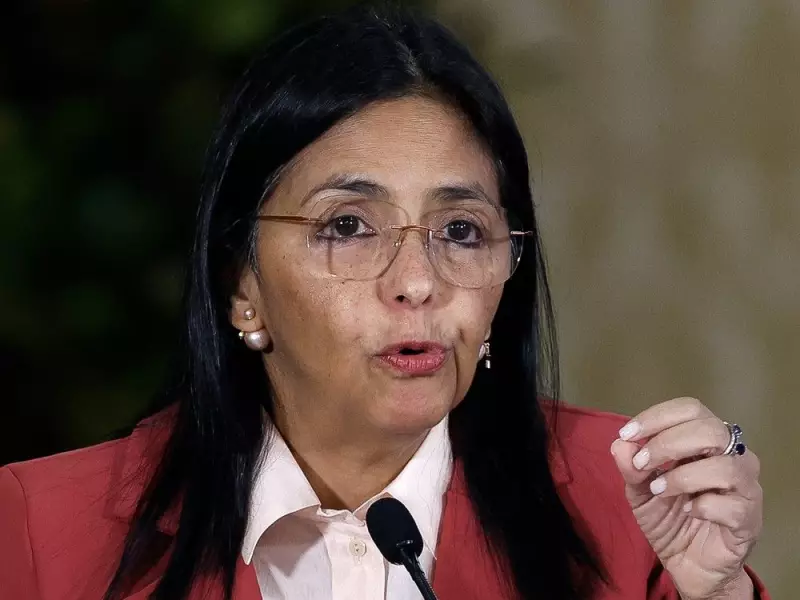
This American narrative was shattered minutes later. In a televised address flanked by high-ranking military officials, Rodríguez delivered a fiery rebuttal. She demanded Maduro's immediate return from U.S. custody, labeling his capture a criminal act. 'He is the country's only president,' she declared, leaving no ambiguity about her loyalty to the detained leader and her rejection of the U.S.-proposed transition.
The Complex Calculus of a Political Transition
The stark contradiction between Washington's statements and Caracas's reality exposes the profound complexities of forcing regime change. Rodríguez, a long-time Maduro confidante who has served as information minister, foreign minister, and most recently oil minister, is viewed by many as the second most powerful figure in the country. Some advisers within the Trump administration reportedly saw her as a potential 'off-ramp' from Maduro's hardline rule, believing a gradual transition under her would cause less instability than an immediate handover to the democratic opposition.
That opposition is led by figures like María Corina Machado, whom Trump dismissed as a 'nice woman' lacking popular support. The U.S. administration's apparent pivot to Rodríguez suggests a pragmatic, if controversial, strategy focused on continuity within Venezuela's existing institutions to maintain order.
However, Rodríguez's allegiance is now openly in question. On state television, she indicated that a congressional chamber was preparing an emergency decree to govern in Maduro's absence, while also leaving a door slightly ajar by mentioning Venezuela's capacity for 'respectful relationships,' a possible hint at future negotiations.
Uncertain Path Forward as World Watches
The international community is now watching to see if this crisis leads to a breakthrough or a deeper stalemate. Following Rodríguez's defiant speech, Secretary of State Marco Rubio told the New York Times he was 'reserving judgment' and would assess her actions. 'We think they’re going to have some unique and historic opportunities to do a great service for the country,' Rubio said, maintaining a thread of diplomatic pressure.
The core challenge remains unchanged: Maduro is widely accused of stealing the 2024 presidential election, and any transition involving his inner circle raises serious doubts about a genuine return to democracy. Furthermore, analysts warn that if the U.S.-backed democratic opposition were to suddenly take power, it would likely require extensive military protection from remnants of the old regime and the powerful drug cartels controlling Venezuela's border regions.

For now, the situation rests on a knife's edge. The United States has executed a bold maneuver by capturing a sitting head of state, but its chosen successor for a political transition has publicly branded that act as a kidnapping. The coming days will reveal whether Delcy Rodríguez's words were a performative display of loyalty or a genuine rejection of American plans, determining the next chapter in Venezuela's prolonged and painful political saga.