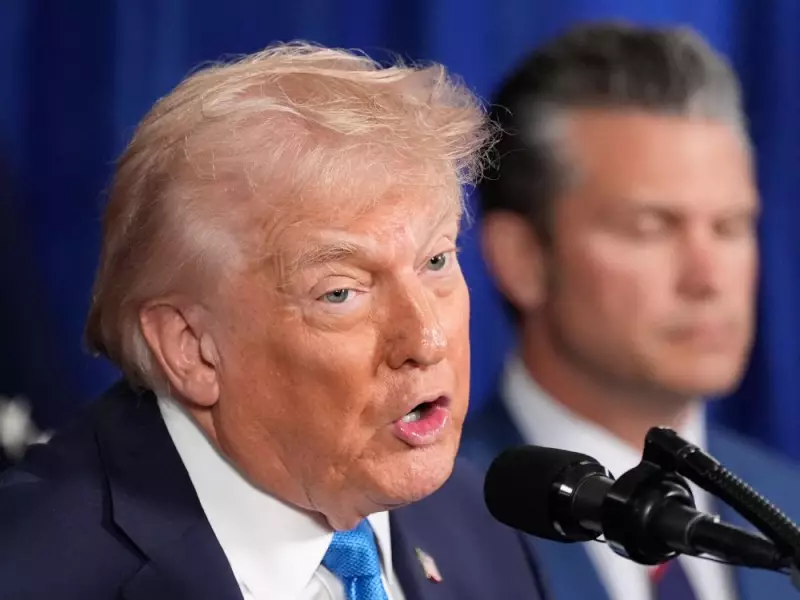
In a dramatic weekend operation, U.S. President Donald Trump authorized military strikes against Venezuela and oversaw the capture of that country's leader, Nicolás Maduro. This action has ignited a fierce debate, not only about the violation of Venezuelan sovereignty but also about a perceived betrayal of Trump's own longstanding opposition to American military intervention abroad.
A Stated Pacifist's Surprising Move
Throughout his political career, Trump has positioned himself as an anti-war candidate and president. At his second-term inauguration in January 2025, he declared his success would be measured "by the wars that we end — and perhaps most importantly, the wars we never get into." This echoed his 2020 boast about "ending the era of endless wars." His weekend decision to attack Venezuela, therefore, represents a stark contradiction that has left observers questioning his core convictions.
The context adds another layer of irony. In October 2025, Trump was reportedly displeased when the Nobel Peace Prize was awarded to Venezuelan opposition figure María Corina Machado instead of himself. Less than three months later, he launched a military operation against Machado's home country, an action that also sidelined its democratically recognized opposition.

The Administration's Legal Justification
The Trump administration has framed the assault not as an act of war, but as an unprecedented law-enforcement operation. U.S. Secretary of State Marco Rubio and Joint Chiefs Chairman Dan Caine stated the action was conducted "at the request of the Justice Department." This framing is seen as a legal maneuver to deploy military force without seeking a formal declaration of war from Congress, which holds that constitutional power.
Maduro was swiftly transported to New York and indicted on charges including "narco-terrorism conspiracy" and "cocaine importation conspiracy." However, this legal approach raises profound questions. Legal experts point out that the indictment itself acknowledges the alleged crimes occurred "out of the jurisdiction of any particular state or district of the United States." Critics argue it establishes a dangerous precedent for the U.S. to prosecute foreign leaders for actions that were not illegal in their own nations.
Pragmatism or a Shift in Doctrine?
Some analysts suggest the move may be rooted in a pragmatic, if controversial, strategy. Trump has a history of coupling peace overtures with threats of overwhelming force. In the spring of 2025, he supported Israeli airstrikes on Iran's nuclear facilities, a move intended to warn adversarial regimes globally. However, Venezuela presents a different case. Unlike Iran, it is not accused of developing nuclear weapons or sponsoring global terrorism on a similar scale.
The Bolivarian regime, first under Hugo Chávez and then Maduro, has long been adversarial toward the United States. Its socialist policies have crippled Venezuela's economy and dismantled its democratic institutions. Yet, as commentators note, these conditions have persisted for years without prompting direct U.S. military action until now. The sudden shift to a kinetic operation, justified under a novel law-enforcement theory, suggests a significant and unexpected evolution in Trump's foreign policy approach.
The events of the past weekend have fundamentally challenged the public's understanding of President Trump's foreign policy principles. What was once seen as a steadfast, genuine aversion to foreign entanglements now appears malleable, leaving allies and adversaries alike to recalibrate their understanding of American intentions on the world stage.