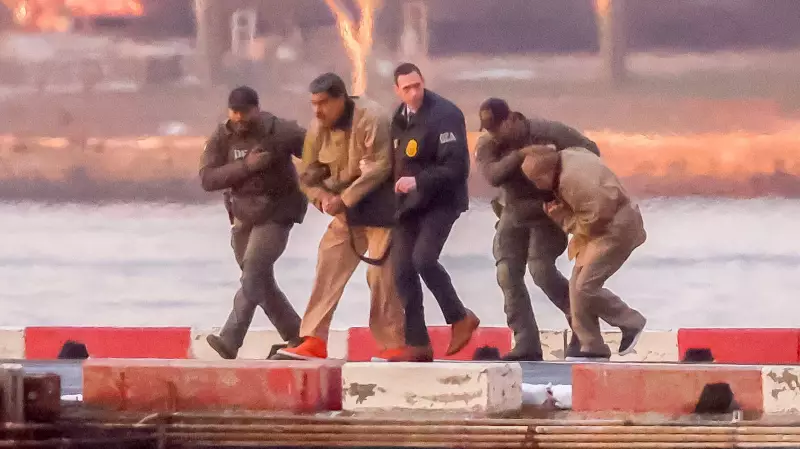
The long-debated puzzle of Donald Trump's foreign policy vision snapped into sharp, startling focus over the weekend. The defining moment came not with a diplomatic communiqué, but with a middle-of-the-night military operation that captured Venezuelan President Nicolás Maduro. This bold action, followed by Trump's declaration that the United States would now "run" the Latin American country, has abruptly ended any speculation that his approach is isolationist. Instead, it has unveiled a doctrine of unbridled imperialism aimed at resource extraction and hemispheric domination.
The Doctrine in Action: From Capture to Control
On Monday, January 5, 2026, a subdued Nicolás Maduro arrived at a Wall Street heliport, en route to a federal court in New York. His capture was the physical manifestation of a policy shift telegraphed in the administration's December National Security Strategy. That document declared a "Trump Corollary"—or what the President calls the "Donroe Doctrine"—to reassert and enforce the Monroe Doctrine and restore American preeminence in the Western Hemisphere.
The administration's intent was made brutally clear on social media, where it posted images from the Maduro operation proclaiming: "This Is Our Hemisphere." In a press conference on January 3, Trump explicitly linked this control to Venezuela's vast oil reserves. "We're going to have our very large United States oil companies, the biggest anywhere in the world, go in, spend billions of dollars, fix the badly broken infrastructure... and start making money for the country," he stated, framing corporate resource extraction as a national benefit.

Dismantling the Post-War Order for a 'Spheres of Influence' World
This aggressive posture represents the active dismantling of the international order constructed after World War II. That system, however imperfectly upheld, was built on institutions and laws designed to protect national sovereignty and deter unprovoked aggression. Trump's vision would replace it with a revival of the late-19th century's "spheres of influence," where great powers divide the world for conquest and economic plunder.
Administration officials now state this reality plainly, discarding the diplomatic niceties of the past. In a CNN interview on Monday, deputy chief of staff Stephen Miller articulated the new creed: "We live in a world, in the real world, Jake, that is governed by strength, that is governed by force, that is governed by power. These are the iron laws of the world since the beginning of time." International laws protecting sovereignty are, in this view, mere "international niceties."
A Return to Roosevelt's Corollary and Open Imperialism
While Trump invokes the Monroe Doctrine of 1823—originally a defensive warning to European powers—his true model is President Theodore Roosevelt's early-20th century "Roosevelt Corollary." Roosevelt transformed the doctrine into a justification for U.S. military intervention as an "international police power" to correct "chronic wrongdoing" and open economic opportunities in the hemisphere.
The Trump Corollary, as executed in Venezuela, seeks a full return to that era of overt imperial control. The threats have extended far beyond Caracas. In recent days, Trump has, while chatting with reporters on Air Force One:
- Threatened to seize Greenland by force from Denmark, with the White House confirming it is exploring options including "utilizing the U.S. military."
- Suggested overthrowing Colombia's democratically elected President Gustavo Petro, saying "Sounds good to me."
- Vaguely threatened to "do something" in Mexico.
- Warned interim Venezuelan President Delcy Rodriguez of "a situation worse than Maduro" if she defies U.S. demands.
Miller defended the claim on Greenland by questioning, "By what right does Denmark assert control over Greenland?... The United States is the power of NATO."

The past five years have seen other regional powers, like Russia and Israel, assert similar rights to dominance with brutal results. The United States, however, had historically—if hypocritically—championed an international order meant to restrain such brutality. That pretense is now fully abandoned. The Trump administration is embracing a system where might makes right, where powerful nations claim a sovereign right to dominate their regions. As one anonymous architect of the Iraq War once said, a sentiment now openly embodied: "We're an empire now, and when we act, we create our own reality." The return to this naked imperialism, experts warn, can only end in global calamity.