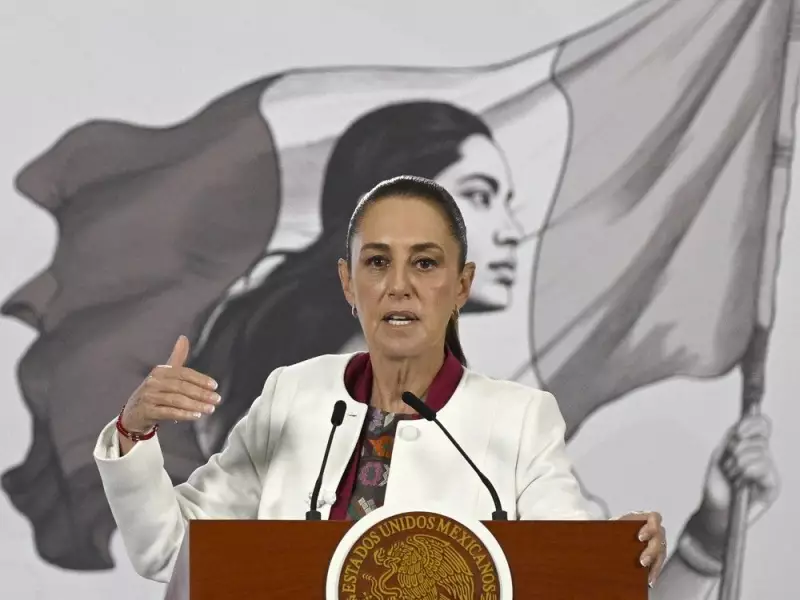
Mexican President Claudia Sheinbaum has publicly dismissed threats from U.S. President Donald Trump about a potential military invasion of Mexico, stating such rhetoric is not to be taken seriously. The comments came during her first press conference following a controversial U.S. operation in Venezuela.
A Firm Rejection of Military Presence
Speaking to reporters on Monday, January 5, 2026, Sheinbaum addressed the escalating rhetoric from the north. "I don't believe in an invasion; I don't think it's something they take seriously," she stated firmly. The president revealed that during their numerous phone conversations, Trump has repeatedly insisted on allowing U.S. military forces to operate within Mexican territory, a proposition she has consistently rejected.
However, Sheinbaum emphasized Mexico's ongoing willingness to cooperate with the United States on shared security challenges, specifically the fight against drug trafficking. She drew a clear distinction between collaboration and capitulation to unilateral military action.

Sovereignty and the Venezuela Precedent
The press conference was Sheinbaum's first since U.S. forces captured Venezuelan President Nicolas Maduro in a raid on Caracas in the early hours of Saturday, January 3rd. Maduro was seized to face drug trafficking charges in the United States. This event has sent shockwaves through Latin America and clearly informed Mexico's response.
Sheinbaum expressed strong opposition to the U.S. intervention in Venezuela, framing it as a matter of principle. "The sovereignty and self-determination of peoples are non-negotiable," she declared. She added that the American continent belongs to its people and not to any foreign superpower.
Echoing this stance, Mexican Foreign Minister Juan Ramón de la Fuente told the annual gathering of Mexican ambassadors that the U.S. actions in Venezuela had "seriously disrupted international legal order." He warned that any further unilateral displays of force would be met with condemnation.
Analysts See a Different Calculus for Mexico
Experts suggest that an invasion of Mexico would represent a far more complex and risky scenario for the United States compared to the operation in Venezuela. Jimena Zúñiga, a Latin America Geoeconomics Analyst at Bloomberg Economics, provided analysis.
"One thing is hitting Venezuela, a country already collapsed under a dictatorial regime that aligned with the U.S.’s enemies," Zúñiga said. "Another thing is Mexico, a democracy of 130 million people sharing a border of more than 3,000 kilometres with the U.S." She noted that under Sheinbaum's leadership, Mexico has been receptive to U.S. demands, making a military escalation less logical.
Trump's Warnings and Regional Fallout
The tension stems from Trump's ongoing frustration with the flow of illegal drugs into the United States. On Sunday, January 4th, he issued warnings to both Mexico and Colombia. "Mexico has to get their act together, because they're pouring through Mexico. And we're going to have to do something," Trump stated, claiming he has repeatedly offered Sheinbaum U.S. military assistance to "clean up" the situation.
He also targeted Colombia, alleging it is "run by a sick man who likes making cocaine and selling it to the United States." Colombian President Gustavo Petro fired back on social media, saying Trump didn't know what he was talking about and should stop his slanderous attacks.
Trump's administration has previously used economic and military tools to combat drug flows, including imposing tariffs on Mexico and Canada over fentanyl imports and having U.S. forces sink suspected drug-trafficking boats in international waters.
President Sheinbaum confirmed she has discussed the Venezuela crisis with the leaders of Spain and Colombia but has no immediate plans to speak with President Trump. The situation leaves a critical diplomatic rift between the neighboring nations, with Mexico steadfastly defending its sovereignty amid heated threats from Washington.