Israeli Military Operations Claim 19 Lives in Gaza Amid Fragile Truce
Israeli military strikes across the Gaza Strip resulted in the deaths of at least 19 Palestinians by midday Wednesday, with hospital officials reporting that the majority of victims were women and children. The Israeli military has pledged to continue these operations, citing them as necessary responses to militant attacks against Israeli soldiers that left one reservist seriously wounded.
Ceasefire Agreement Tested by Ongoing Violence
The latest casualties represent a significant challenge to the ceasefire agreement that took effect on October 10, 2025. This U.S.-backed truce was designed to halt more than two years of intense conflict between Israel and Hamas, yet it has been repeatedly punctuated by deadly Israeli strikes that have claimed Palestinian lives.
According to Gaza health officials, more than 530 Palestinians have been killed by Israeli forces since the ceasefire implementation began. In contrast, Israel's military reports that four Israeli soldiers have been killed during the same period. The escalating Palestinian death toll has prompted eight Arab and Muslim nations, including mediation partners Egypt and Qatar, to condemn what they describe as Israel's "repeated violations" of the ceasefire terms.

Heartbreaking Details of Wednesday's Casualties
Hospital officials provided devastating details about Wednesday's victims:
- Five children, including a 5-month-old infant and a baby just 10 days old
- Seven women
- A Palestinian Red Crescent paramedic on duty
Dr. Mohamed Abu Selmiya, director of Gaza City's Shifa Hospital, expressed profound frustration in a Facebook post, questioning: "The genocidal war against our people in the Gaza Strip continues. Where is the ceasefire? Where are the mediators?"
Multiple Incidents Across Gaza Strip
The violence unfolded across multiple locations throughout Wednesday:
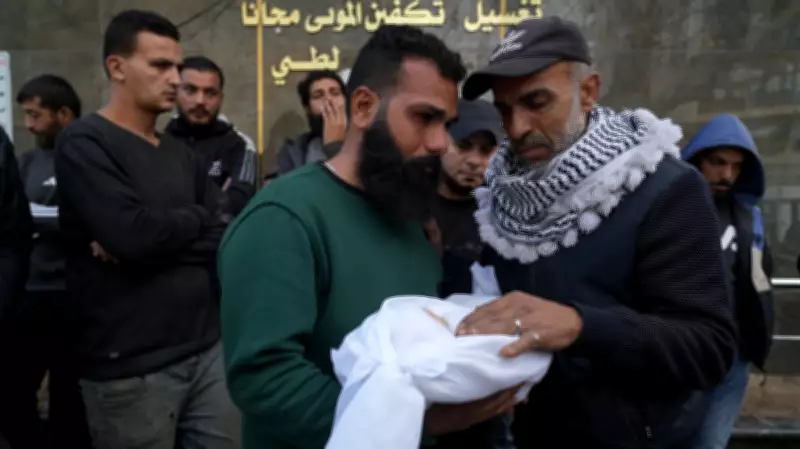
Early Morning Strike in Tuffah Neighborhood: Israeli troops targeted a building in north Gaza's Tuffah neighborhood, killing at least 11 people, most from the same family. The victims included two parents, their 10-day-old daughter, her 5-month-old cousin, and their grandmother.
Mourners gathered at Shifa Hospital for funeral prayers, with family member Mohammad Jaser asking heartbreaking questions: "What did this child do? Was she affiliated with Hamas or Fatah? Why are they killing the children?"
Afternoon Attacks in Khan Younis and Gaza City: Later strikes continued the deadly pattern:
- An Israeli strike on a family's tent in Khan Younis killed three people, including a 12-year-old boy
- Tank shelling in Gaza City's Zaytoun neighborhood killed another three Palestinians, including a husband and wife
- A strike on a tent in Khan Younis' Muwasi area killed at least two people and wounded five others
The paramedic killed in the Muwasi attack was identified as Hussein Hassan Hussein al-Semieri, who was on duty with the Palestinian Red Crescent at the time of his death.
Mixed Progress on Ceasefire Implementation
While violence continues, some aspects of the ceasefire agreement have seen forward movement:
- Hamas has released all hostages it was holding
- Israel has released several thousand Palestinian prisoners
- Increased humanitarian aid has entered Gaza
- The Rafah border crossing has opened for limited civilian movement
- A new technocratic committee has been appointed to administer Gaza's daily affairs
However, critical elements remain stalled, including the deployment of an international security force, the disarmament of Hamas, and the reconstruction of Gaza's devastated infrastructure. The United States has provided no timeline for when these components might be implemented.
Broader Conflict Context
The Gaza health ministry, which maintains detailed casualty records generally considered reliable by United Nations agencies and independent experts, reports that over 71,800 Palestinians have been killed since the war began. The ministry does not distinguish between combatants and civilians in its totals.

The Israeli military maintains that its continuing strikes represent necessary responses to Hamas violations and militant attacks against Israeli soldiers. An Israeli military official, speaking anonymously in accordance with military policy, told The Associated Press that Wednesday's operations specifically responded to militant gunfire that seriously wounded a reservist soldier that morning.
As the fragile ceasefire continues to be tested by violence, Palestinians in Gaza express growing disillusionment with the agreement, with many stating that it doesn't feel like the war has truly ended despite the formal truce.