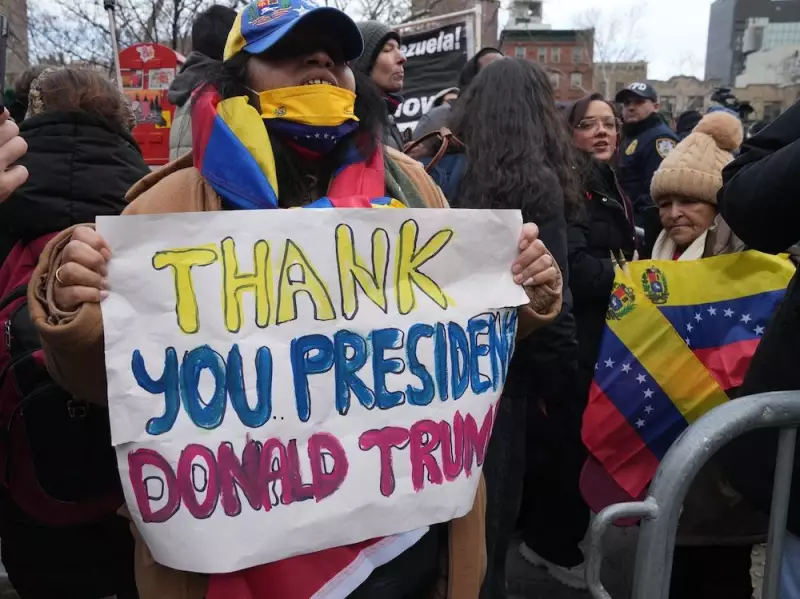
The dramatic arrest of Venezuelan dictator Nicolás Maduro by the United States has ignited a fierce global debate, pitting moral imperatives against strict interpretations of international law. While the operation has been celebrated by many across Latin America, a chorus of criticism, notably from Western progressive circles, has labeled it as destabilizing and illegal.
The Flawed Comparison to Past Failures
Critics frequently point to the United States' troubled ventures in Iraq and Afghanistan as proof that regime change in Venezuela is doomed. However, this comparison is fundamentally flawed. The failures in the Middle East stemmed from imposing Western democratic structures on societies with no foundational experience or cultural appetite for them. This led to institutional corruption and unchecked sectarian conflict.
Venezuela's history is starkly different. The nation enjoyed over four decades of democratic rule before its descent into authoritarianism in the 2000s. It possesses crucial assets for a successful transition: a resilient civil society, a strong national identity, and a unified opposition movement. This context makes Venezuela less comparable to Middle Eastern states and more analogous to another Latin American nation: Panama.

The Panama Precedent: A Blueprint for Success?
In the 1980s, Panama fell under the dictatorship of General Manuel Noriega, following a period of imperfect democracy. Like Maduro, Noriega was deeply implicated in international drug trafficking and money laundering. In 1989, the U.S. intervened militarily, abducted Noriega, and brought him to Florida for trial—an operation widely criticized as violating international law and conducted without congressional approval.
The outcome, however, was remarkably positive. Washington ensured the reinstatement of Panama's annulled 1989 election results. With a clear, American-backed transition, Panamanian democracy was restored and the economy flourished. Today, Panama boasts the third-highest per capita GDP in Latin America, demonstrating that regime change can foster enduring stability when the preconditions are favorable.
International Law Versus Moral Action
Some detractors argue that Maduro's detention, regardless of the potential outcome, was wrong because it undermined the international legal order. This position, however, ignores the reality of how international law functions. Nations adhere to it primarily when it serves their mutual self-interest in low-stakes areas like trade. In high-stakes conflicts involving national security or profound humanitarian crises, compliance often falls away, as there is no supreme global enforcer.
The moral case for action is rooted in the suffering of the Venezuelan people. Millions have fled the country due to extreme hunger and violence under Maduro's regime. Framing the debate solely around legal technicalities overlooks this human catastrophe. Whether Venezuela will replicate Panama's success remains uncertain, particularly given the undefined nature of President Donald Trump's transition plans. Yet, dismissing the possibility based solely on irrelevant Middle Eastern analogies is an intellectual shortcut that ignores Venezuela's unique historical and cultural landscape.
The arrest of Nicolás Maduro presents a complex dilemma where realpolitik, morality, and law intersect. While the legal questions are valid, the argument for action based on the alleviation of human suffering and the historical precedent for successful democratic restoration in the region carries significant weight.