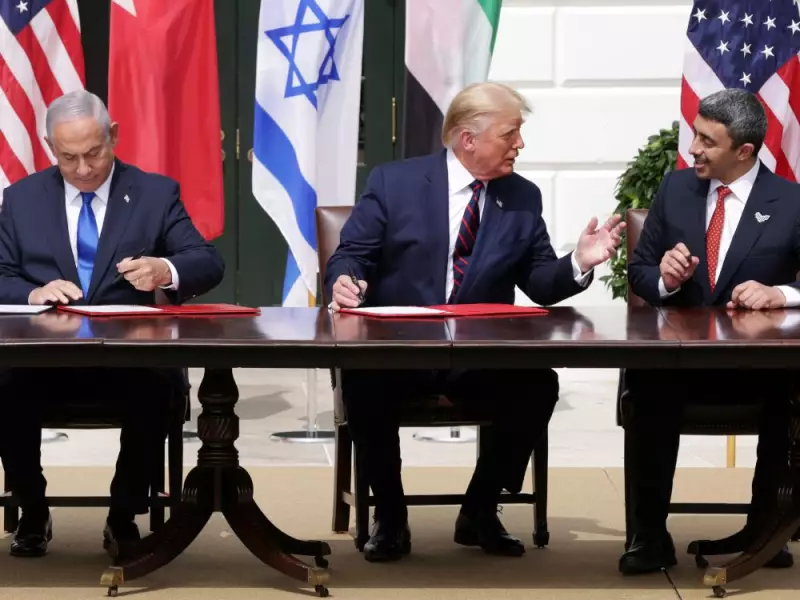
While former U.S. President Donald Trump's detailed Gaza peace plan received significant acclaim, a compelling argument suggests that a different diplomatic achievement will hold greater historical weight. According to analyst Loay Alshareef, the transformative breakthrough for the modern Middle East is not a single plan but the foundational Abraham Accords of September 15, 2020.
A Foundation for Peace, Not Just a Truce
Alshareef contends that the Abraham Accords, brokered by the Trump administration team including Jared Kushner, Avi Berkowitz, and David Friedman, represent the most significant U.S. foreign policy success in the region since the 1978 Camp David Accords. Unlike the earlier peace agreements between Israel and Egypt (1979) and Jordan (1994), which established a necessary but often cold diplomatic peace, the Abraham Accords were designed with a different core philosophy.
Those earlier treaties successfully ended wars and stabilized borders, but they largely failed to integrate the societies they connected. The Abraham Accords, in contrast, were conceived as an engine for social transformation, placing people-to-people relations at the heart of lasting peace.

From Paper Peace to People's Peace
The immediate impact of the accords, which normalized relations between Israel and the United Arab Emirates, Bahrain, and later Morocco, was a surge in direct human connection. For the first time, Israeli tourists explored Dubai's markets, Emirati students visited Jerusalem, and joint business ventures flourished. Jewish and Muslim influencers collaborated on social media, modeling a new narrative of coexistence.
This shift marked a profound departure from decades of political denial in the region—denial of Israel's right to exist and of the Jewish people's historical connection to the land. Alshareef argues that the accords shattered this wall by embracing a realism that acknowledges indigenous Jewish roots from Hebron to Tel Aviv. This recognition, he suggests, does not weaken the Palestinian cause but potentially liberates it from a cycle of rejectionism, paving the way for genuine negotiation much like Anwar Sadat's historic 1977 visit to Jerusalem did for Egypt.
A Return to a Legacy of Cooperation
The vision underpinning the Abraham Accords finds precedent in the region's own history. Alshareef points to the Abbasid Caliphate in Baghdad, where Jewish and Muslim scholars worked side-by-side to translate Greek texts, preserving knowledge for future generations. Similarly, in Al-Andalus (Muslim Spain), a pragmatic coexistence allowed for vibrant intellectual exchange between faiths.
By fostering direct economic, tourist, and cultural ties, the Abraham Accords aim to rebuild that pragmatic tradition of cooperation. They move beyond government-level agreements to create a peace lived and experienced by citizens, making friendship itself a courageous political act. While Trump's 2020 Gaza plan addressed immediate crises, Alshareef posits that the Abraham Accords laid the indispensable groundwork for a more stable and integrated Middle Eastern future.