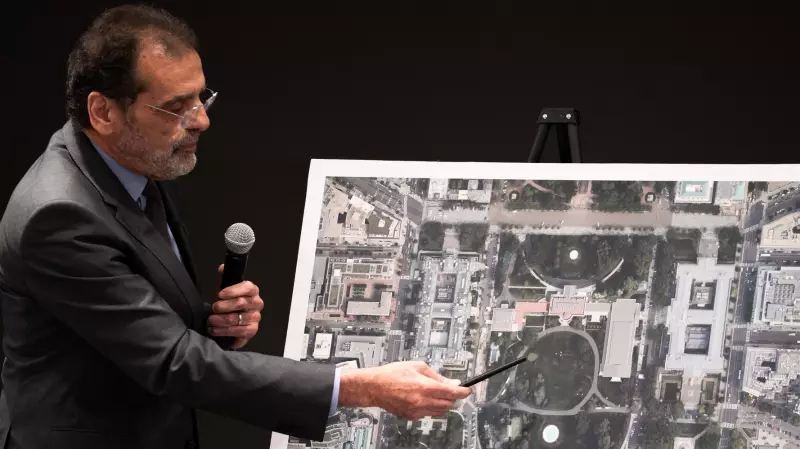
The White House has provided its most detailed explanation to date for the controversial demolition of its East Wing, stating that severe structural problems made saving the building infeasible. Officials presented plans for a new, $400 million ballroom to the federal panel that must approve the project, arguing demolition was more economical than renovation.
Structural Decay and a Costly Solution
During a public meeting of the National Capital Planning Commission on Thursday, Josh Fisher, the White House Office of Administration director, laid out the reasons for tearing down the East Wing. He cited an unstable colonnade, persistent water leakage, mold contamination, and other major concerns.
"Because of this and other factors, the cost analysis proved that demolition and reconstruction provided the lowest total cost ownership and most effective long-term strategy," Fisher told the commissioners.

The project's architect, Shalom Baranes, joined the presentation, showing renderings of the planned ballroom. The design could involve adding a second story to the West Wing colonnade to create visual symmetry with the new eastern structure, a move that would notably change the iconic area outside the Oval Office.
Scrutiny and Concerns from Commissioners
The presentation did not escape critical questions. The most vocal was Democrat Phil Mendelson, who also chairs Washington's D.C. Council. He raised issues about the ballroom's massive scale and its location.
Mendelson questioned the planned ceiling height of 38 to 40 feet (11.5 to 12 meters), stating, "It still seems to me it’s overwhelming the existing building." Baranes assured him the height was meant to match the White House and that the final number wasn't fixed.
Mendelson also asked why the full project wasn't presented before the East Wing was demolished last October. Fisher responded that some aspects were of a "top secret nature." Commission chairman Will Scharf, a top White House official, reiterated the panel typically lacks jurisdiction over preliminary demolition work.
A Growing Project Amid Legal Challenges
The ballroom project has expanded significantly since first proposed. President Donald Trump, now in his second term, has discussed it for years. Initial plans last July outlined a 90,000-square-foot space for 650 guests at a $200 million cost.
By October, the East Wing was gone. In December, the estimated price tag doubled to $400 million, with capacity increased to 999 people. The White House maintains private donations, including from the president, will fund it.
The project faces a lawsuit from the National Trust for Historic Preservation, accusing the administration of violating federal law by starting work before independent reviews and public comment. After the meeting, the Trust's president called the presentation a "good and necessary first step" but urged full compliance with all legal processes.
Chairman Scharf expressed confidence the commission would ultimately approve the project following a more formal review, including public testimony, expected after a detailed proposal is submitted. The panel's next meeting is scheduled for February 5.